


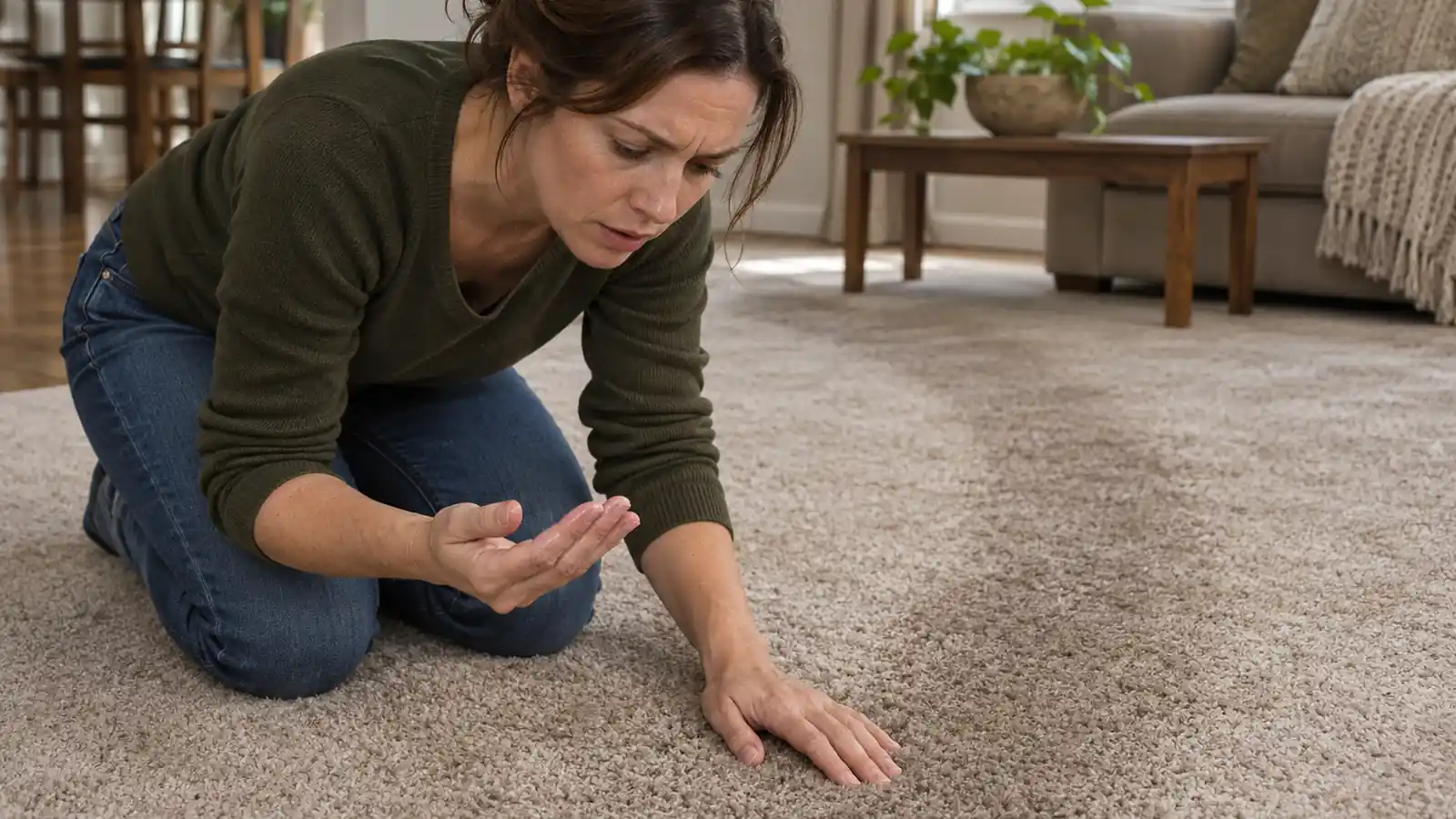
If your carpet feels sticky after cleaning, do not assume it is simply “extra clean” or that the fibers need time to soften. Carpet can feel different while it is still damp, but tackiness that remains after complete drying often points to cleaning solution or spill residue left in the pile.
That residue can then hold dust, grit, and oils from normal foot traffic, making the carpet look dirty again sooner than expected.
The useful question is not just whether the carpet feels sticky. It is when the symptom appeared, where it occurs, and what the area does after it dries and receives foot traffic. Those clues help separate rapid resoiling from wicking, ordinary dampness, and permanent wear.
Why a Clean-Looking Carpet Can Become a Soil Collector
Carpet cleaning has two connected jobs: loosen unwanted material and recover it. A cleaning agent may help release oily soil, spills, or earlier product buildup, but the suspended material and cleaning solution still have to leave the carpet through rinsing, extraction, or the removal process specified for that product.
If too much solution is applied, the mixture is too concentrated, or recovery is incomplete, some residue may remain on the fibers. The Carpet and Rug Institute defines resoiling as the tendency of cleaning-solution residue to attract soil at an accelerated rate. Current
| What you notice | When it appears | More likely explanation | Best next step |
|---|---|---|---|
| Carpet feels tacky or coated after drying | Immediately after drying | Cleaning or spill residue | Stop adding product and request a rinse-and-extraction assessment |
| Area looks clean at first, then darkens with use | Over days or weeks | Rapid resoiling as new soil adheres to residue | Limit traffic, vacuum dry soil, and address the residue |
| The same spot or ring returns as the carpet dries | Within the drying cycle | Wicking from deeper carpet layers | Let it dry fully and report the recurring spot |
| Carpet is only cool, damp, or slightly draggy | Before drying is complete | Remaining moisture | Improve airflow and reassess when fully dry |
| A lane stays dull but is not sticky | Before and after cleaning | Flattened or worn fibers may be changing how light reflects | Compare it with protected carpet and assess wear separately |
Likewise warns that detergent residue can become sticky and cause rapid resoiling.
The progression usually looks like this:
- Cleaning solution loosens soil in the carpet.
- An incomplete rinse or weak recovery leaves some solution and suspended material behind.
- The carpet dries, but the affected fibers feel tacky, stiff, or coated.
- Shoes, socks, pet paws, and airborne dust bring new soil into contact with the residue.
- The affected area darkens faster than nearby carpet.
This explains why a carpet may look good immediately after cleaning yet develop gray traffic paths or repeat dark spots later. More detergent does not solve that cycle. It adds more material that must be removed.
Use Timing, Touch, and Pattern to Identify the Problem
Several post-cleaning problems can look similar from across the room. Waiting until the carpet is dry and noting the pattern gives you more useful evidence than immediately treating it again.
Wicking deserves special attention because it is often confused with rapid resoiling. The IICRC describes wicking as water-soluble material moving upward or outward on fibers during drying. A returning spot can therefore be old material coming back to the surface, while resoiling is new soil attaching unusually quickly after cleaning.
What to Do Before You Clean the Carpet Again
The safest response depends on whether the carpet is still damp, dry and sticky, or showing a returning mark. Restraint matters because another round of product or excess water can blur those distinctions.
If the carpet is still damp
- Keep shoes, pets, and unnecessary traffic off the area.
- Use the ventilation and drying instructions provided by the cleaner or carpet manufacturer.
- Do not judge the final texture or color while the fibers are still wet, and do not place furniture directly on damp carpet unless the cleaner has protected the contact points.
If the carpet is dry and still sticky
- Do not add shampoo, dish soap, fragrance, or a second spot remover.
- Record where the texture occurs and which products were used, including anything applied before the main cleaning.
- If a professional performed the work, contact that provider and ask for an inspection focused on residue, rinsing, and extraction.
- For a small spot, follow the carpet manufacturer’s instructions.
- Some guidance permits a light clean-water rinse followed by thorough blotting, but this is not a universal whole-room remedy.
- Wool, natural fibers, unfamiliar dyes, and heavily wetted areas need more caution.
- Avoid soaking the backing or pad.
If the texture is widespread, the area repeatedly darkens, or earlier DIY products may have accumulated, a professional carpet cleaning assessment can determine whether corrective rinsing and extraction are appropriate.
If a spot returns during drying
- Treat the timing as evidence.
- Let the area finish drying, photograph the spot, and note whether it has the same outline as the original spill.
- A recurring mark may require targeted treatment below the visible fiber rather than more detergent on top.
- Tell the cleaner about the spill, previous spotters, pet accidents, and every cleaning attempt you remember.
Prevent the Residue-and-Resoiling Loop
Prevention is mostly a matter of controlling product, recovery, moisture, and traffic. These habits reduce the chance that a freshly cleaned surface becomes harder to maintain.
- Follow the exact dilution and removal directions for the carpet and cleaning product.
- Do not increase detergent strength because a spot looks stubborn.
- Remove as much loose dry soil as practical before wet cleaning.
- Use only equipment and methods appropriate for the carpet construction.
- Make adequate recovery passes when using an extractor.
- Keep traffic off the carpet until it is fully dry.
- Clean entry mats so they do not return captured grit to the room.
- Address recurring traffic lanes according to soil load and fiber condition, not with repeated spot spraying.
- Our guide to high-traffic carpet maintenance explains how to separate embedded soil from wear.
The Decision Rule: Remove Residue, Do Not Feed It
When dry carpet feels sticky and then gets dirty unusually fast, residue and incomplete recovery deserve attention. When a mark returns during drying, wicking is a better starting hypothesis. When a dull lane never feels sticky, wear or pile distortion may be contributing.
Those distinctions prevent the most common mistake: adding more cleaner to a carpet that already needs less product and better removal. Let the carpet dry, document the timing and pattern, and match the corrective step to the actual symptom.
Frequently Asked Questions
Dry carpet that remains tacky or coated may hold detergent, spot-remover, spill, or oily residue. The location offers a clue: widespread stickiness can follow a full cleaning, while one sticky patch may trace to a spill or earlier spot treatment.
Carpets can get dirty again quickly when residue attracts new soil, when people walk on it before it is dry, or when oily material is not fully removed. A spot that reappears during drying may instead be wicking from deeper layers, and a dull traffic lane may partly reflect wear.
Vacuuming helps remove dry soil, but it does not reliably remove sticky residue. A rinse-and-extraction process may be needed, depending on the carpet, product, and amount left behind.
For a small area, some manufacturer and CRI guidance permits light rinsing and thorough blotting. Do not saturate the carpet or assume repeated whole-room water passes are safe. Check the manufacturer’s care instructions, and use professional help for widespread residue, natural fibers, uncertain dyes, or persistent dampness.
No. A stain that returns as the carpet dries is more consistent with wicking. Rapid resoiling develops after the carpet is dry, when residue collects new dust, grit, and oils carried through normal use.
Yes. Damp carpet can accept soil from shoes, socks, and pet paws before it is ready for normal use. Traffic can also slow drying. Follow the cleaner’s instructions and keep use to a minimum until the carpet is fully dry.
Not necessarily. Residue can change how carpet feels without permanent fiber damage. However, unsuitable chemicals, aggressive scrubbing, excess moisture, or repeated treatments can cause discoloration, texture change, or backing problems, so avoid experimenting with stronger mixtures.
Contact the cleaner when the carpet is fully dry but still sticky, when a large area darkens unusually fast, when a spot returns, or when dampness persists beyond the expected drying time. Share photos, the affected locations, and a list of products previously used.