


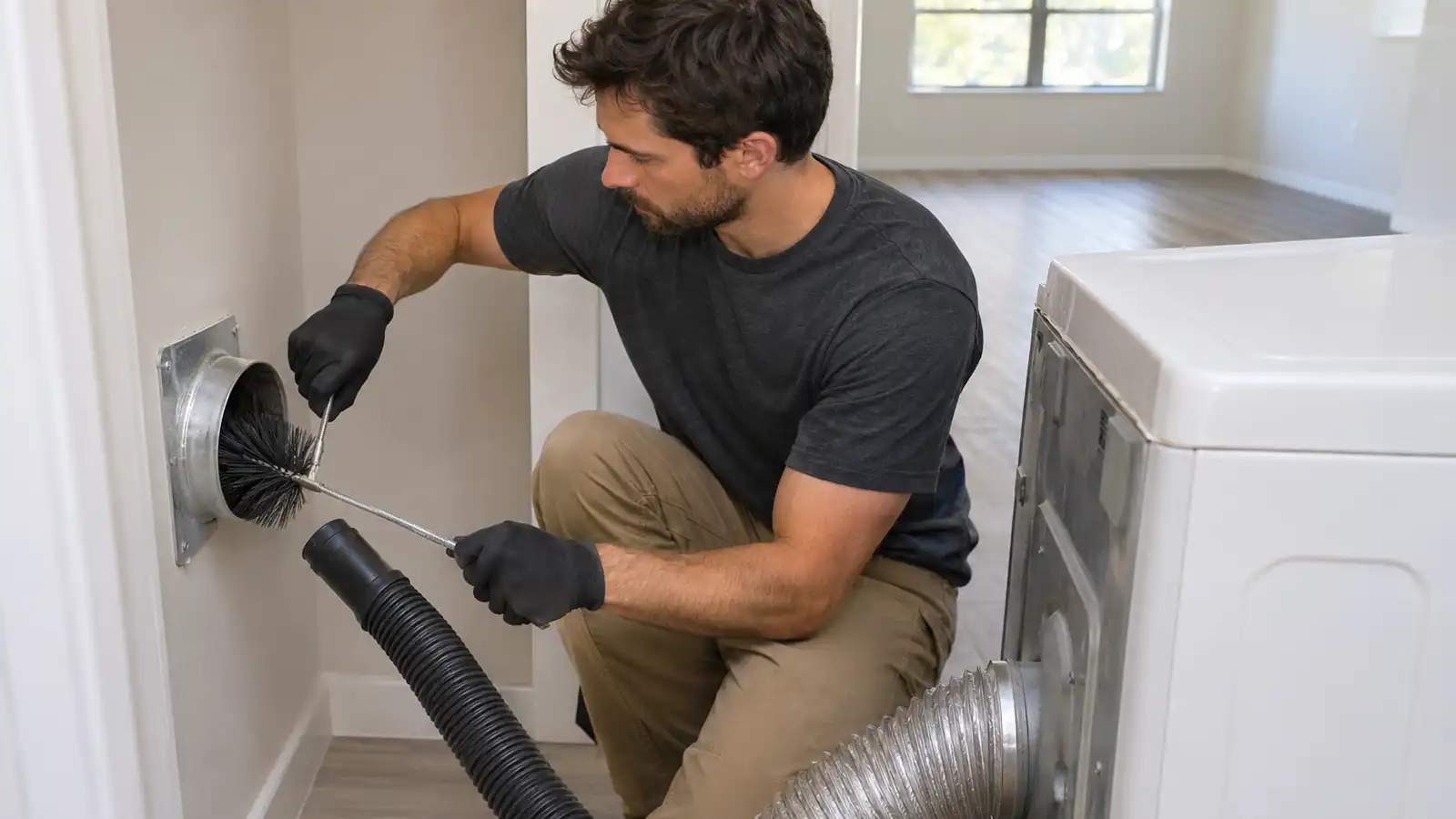
Apartment turnover creates one of the few predictable opportunities to reach an in-unit dryer connection without coordinating around a resident’s schedule. It does not tell you whether the vent was cleaned recently, whether the concealed run was reached, or whether the exterior termination belongs only to that unit.
A reliable turn treats the exhaust path as a scoped maintenance item, not a box labeled “dryer done.” The goal is to leave a clear record of what was accessible, what was serviced, and what still needs qualified attention.
Turnover Is a Checkpoint, Not the Whole Maintenance Plan
The question of how often a landlord should clean dryer vents cannot be answered from the lease calendar alone. Use turnover to verify the record and current condition, then apply the property’s maintenance policy, the dryer manufacturer’s instructions, and any earlier warning signs.
Turnover does not reset the vent clock. A unit vacated after six months may have recent, documented service, while a long tenancy may leave an unknown history. The evidence should drive the next action.
| Record or condition | Turnover action |
|---|---|
| Recent documents identify the route and completed scope; no new symptom is reported | Verify accessible connections and the termination, then follow the established review interval |
| Service date or route is unknown | Map the route and assess accessible sections before closing the work order |
| The dryer takes two cycles or drying time has increased | Check the lint screen, load and settings, transition duct, exhaust path, and appliance performance; do not assume one cause |
| The transition duct is detached, crushed, damaged, or made from questionable material | Record the condition and refer it for qualified correction; cleaning is not a repair |
| A concealed segment or exterior termination cannot be reached | Mark that segment inaccessible or deferred, assign the next action, and do not record the full route as completed |
Treat the Exhaust Path as Three Access Zones
An apartment dryer vent may cross spaces controlled by different people or vendors. Separating the path into zones prevents an in-unit visit from being mistaken for full-route service.
At the Appliance
- Start with the lint-screen area, dryer connection, and short transition duct behind the appliance.
- Record whether the appliance is property-owned or resident-owned, whether it can be moved safely within the authorized scope, and whether the transition duct is attached and visibly intact.
- Cleaning should not be used to conceal a damaged or unsuitable connection.
Through the Building
The fixed exhaust run may pass behind walls or ceilings before it reaches outdoors.
- Confirm its configuration from reliable property information or a qualified assessment instead of guessing from the nearest exterior hood.
- If records indicate that more than one dryer connects to an engineered common exhaust system, do not treat it as a standalone unit run.
- Refer the system to a provider qualified for that design.
Our article about long or concealed dryer vent runs explains why hidden routing and bends can change access and airflow.
At the Termination
The route may end at a wall, roof, or another designated exterior location.
- Note whether the outlet can be identified, whether the flap or damper operates, and whether safe access requires specialized equipment or building coordination.
- Do not send ordinary turnover staff onto a roof or into a restricted space to complete a checklist.
Use Vacant-Unit Access to Close the Right Work Order
A vacant unit removes one scheduling barrier, but the job can still depend on keys, appliance movement, common-area access, roof access, or another trade. Define those dependencies before the vendor arrives.
For properties subject to HUD’s NSPIRE inspection standards, the dryer-exhaust standard evaluates deficiencies at the unit, inside the building, and outside. That is not a universal rule for every apartment, but it illustrates why one checked location cannot represent the whole route.
- Review the prior work order, invoice, photos, resident complaints, and next-due date.
- Identify the appliance, transition connection, fixed run, and exterior termination as far as reliable records allow.
- Confirm who can authorize entry to each area, who will move the appliance, and which access points the scheduled scope includes.
- Complete the authorized cleaning or inspection while recording damage, inaccessible sections, and work that belongs to another qualified provider.
- Reconnect and verify only what the scope allows, record the test or observation used, and keep unresolved items open with an owner and next step.
Write the Record for the Next Turnover
A useful maintenance record describes the route and result, not only the vendor and date. A current cleaning date does not prove every segment was reached.
| Record field | What to capture |
|---|---|
| Asset | Property, building, unit, appliance ownership, fuel type, and model when available |
| Route | Transition duct, fixed run, and termination; dedicated, shared, or unknown configuration |
| Access | Sections reached, inaccessible sections, keys or escort required, and deferred areas |
| Starting evidence | Last verified service date, work-order number, complaint, alert, or observed condition |
| Completed scope | Exact sections cleaned or assessed and the method or test actually reported |
| Results | Observations, measurements if taken, photos, and reconnection status |
| Exceptions | Damage, questionable material, access failure, repair referral, responsible party, and follow-up date |
| Next review | Calendar date or earlier trigger, with the policy or manufacturer guidance used |
These fields are an operational recommendation, not a universal legal form or retention schedule. Your lease, property policy, insurer, governing documents, and applicable law may impose different requirements.
The same principle can support a broader rental turnover cleaning checklist: each task should retain a scope, result, exception, and next action.
A Two-Cycle Complaint Is a Trigger, Not a Diagnosis
When a dryer is taking longer to dry clothes or takes two cycles to dry, record it as a symptom that needs a clear troubleshooting path. The Consumer Product Safety Commission notes that longer-than-normal drying can indicate a blocked lint screen or exhaust duct, but other conditions can produce the same complaint.
- Load or washer condition: Oversized loads, unsuitable settings, or clothing that leaves the washer unusually wet can extend drying time.
- User-maintenance items: A loaded lint screen or residue on an accessible sensor can affect performance, depending on the model.
- Exhaust path: A crushed transition duct, restricted run, or obstructed termination can limit airflow.
- Appliance or installation issue: Heating, sensing, power, fuel, or installation problems may require appliance-specific or trade-specific diagnosis.
If cleaning is completed and the complaint remains, do not keep repeating the same work order. Preserve the result and route the unresolved symptom to the appropriate qualified provider.
A burning odor, smoke, scorching, or repeated overheating or shutdown is a reason to stop using the dryer and seek qualified evaluation. Active smoke or fire requires emergency response.
We offer dryer vent cleaning. For an apartment turnover, contact Williams Carpet Care to discuss the unit’s route and access points so we can confirm whether the requested work fits our current scope.
Close the Turnover With a Route-Level Status
A useful closeout has one of four honest outcomes: the defined scope was completed; a repair or specialist referral remains open; access or another dependency remains open; or no cleaning was due after a documented review.
That is more useful than “dryer vent checked.” Turnover becomes a dependable maintenance checkpoint when the route, completed scope, exceptions, and next trigger stay attached to the unit record.
Frequently Asked Questions
No. Verify the route, last completed scope, current condition, and property schedule at every turnover. Clean when the established interval, manufacturer guidance, symptoms, or inspection results indicate that service is due.
• Treat the scope as unclear.
• Request supporting details if they are available, then verify the appliance connection, fixed run, and termination rather than assuming the entire path was serviced.
Not as a full-route completion. Record which portions were completed, mark the outlet as inaccessible or deferred, and assign the access or follow-up work to a named party.
• Separate appliance ownership from the building’s exhaust path.
• Document whether the appliance is present, whether the connection can be assessed, who may move or reconnect it, and which components remain the property’s responsibility under the lease and applicable rules.
No. If property records show an engineered common exhaust system, it may have different equipment, access points, and maintenance requirements. Use a provider qualified for that design rather than treating it as one apartment’s standalone duct.
• State that no operating test was performed.
• Record what could be observed at the connection, fixed run, and termination, along with any inaccessible sections.
• Do not mark airflow or appliance performance as verified.
• Follow the lease and applicable state and local requirements for notice and entry.
• Confirm the appointment, preparation, appliance access, keys or escort, and missed-access procedure in advance.
• Do not assume one notice period applies everywhere.
The invoice may support the property-level record, but each unit should still have its own route, completed scope, result, exception, and follow-up status. Otherwise, a later manager cannot tell which units or segments were actually completed.