


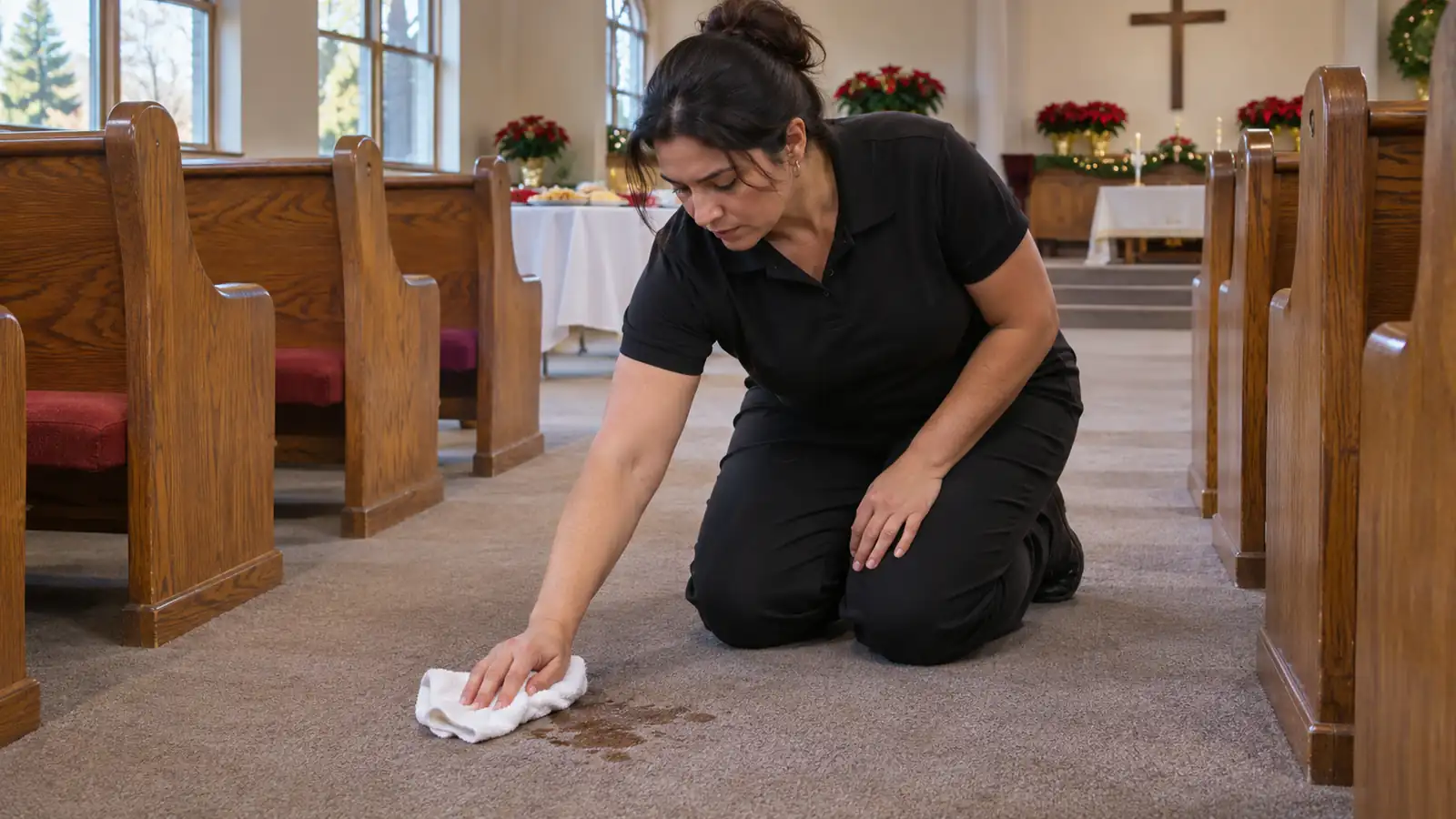
A Christmas concert, community meal, watch-night service, or children’s program can leave several different carpet problems behind. Punch may spill near fellowship tables, wet grit may collect inside the entrance, and hundreds of footsteps may darken the same sanctuary aisles. Treating all three as “stains” can lead to wasted effort or the wrong cleanup method.
Church carpet cleaning after a holiday event works best when the building team follows the event route, records what happened, and chooses the scope from the carpet’s actual condition!
One fresh spill may need localized attention. A connected path of soil from the doors to the fellowship hall may justify cleaning the route. Widespread dullness across several spaces may call for broader work.
Start With the Route People Used
The room with the largest crowd is not always the only area that needs attention. Soil travels through connected spaces, and holiday guests may move from parking areas to the narthex, sanctuary, classrooms, fellowship hall, and kitchen.
Walk the route in this order:
- Check the exterior approach and both sides of each entrance mat.
- Inspect the first carpeted area inside the door and every hard-floor-to-carpet transition.
- Follow the main aisles, turns, and gathering points rather than scanning only open floor space.
- Review food and beverage areas, including routes between the kitchen and fellowship tables.
- Look under chairs and along pew rows for crumbs, cup marks, and spills that volunteers may not have seen.
This route-based inspection connects the source to the visible result. An overloaded mat can stop trapping soil. A dirty hard-floor transition can feed residue onto nearby carpet. A drink spill may be small, while footsteps spread it beyond the original cup mark.
Run a Post-Event Closeout Before Details Are Lost
The people who saw a spill often know more than the person cleaning the building the next morning. A brief closeout gives the facility lead useful information without turning volunteers into carpet technicians.
- Ask event staff to report the room, nearest landmark, and approximate time of each spill.
- Record what was spilled and whether anyone applied water, soap, stain remover, or another product.
- Mark unresolved spots with a removable note placed beside, not on, the carpet.
- Photograph dark areas before repeated spot treatment so the team can compare them after vacuuming and full drying.
- Note the next service, rehearsal, class, or rental that will need the space.
- For a fresh spill, gently lift semisolid food and blot liquid with a clean white absorbent cloth.
- Do not scrub.
The Carpet and Rug Institute’s commercial carpet guidance recommends prompt spill response and products that will not damage the carpet or encourage rapid resoiling. Follow the carpet manufacturer’s care instructions, and stop if the fiber, dye, prior product, or suitable treatment is uncertain.
Separate Spills, Tracked Soil, and Aisle Wear
These conditions can appear during the same walkthrough, but they do not call for the same response.
| Condition | What to inspect | Practical response |
|---|---|---|
| Food or drink spill | Location, spill type, size, odor, and products already used | Blot a fresh spill, document it, and use carpet-compatible spot care; request evaluation when the mark persists, returns, or has spread |
| Entryway soil | Mats, dampness, loose grit, first carpeted steps, and nearby transitions | Clean or replace overloaded mats, remove dry soil, and inspect the connected route before deciding where wet cleaning is needed |
| Dark or flat aisle | Appearance after thorough vacuuming, pile texture, fraying, open seams, ripples, and protected carpet nearby | Evaluate embedded soil separately from wear or damage; cleaning may improve soiling but cannot rebuild missing or abraded fibers |
Vacuum loose, dry material before judging the carpet’s color. Give entrances, aisle centers, turns, and fellowship routes slow, overlapping passes with equipment suitable for the installed carpet. A dark lane that improves after dry-soil removal is different from a frayed or sparse lane that remains physically changed.
Match the Cleaning Scope to the Soil Pattern
A post-event plan should be large enough to address connected soil, but not automatically expand one mark into a whole-building project.
Localized treatment
This may fit a recent, contained spill when the surrounding carpet is otherwise well maintained, and there is no recurring odor or broad traffic discoloration. Removal cannot be guaranteed because food color, heat, prior products, and fiber changes can affect the result.
Connected-route cleaning
This may make sense when the entrance, narthex, main aisle, or fellowship path shows the same tracked soil pattern. Treating only the darkest patch can miss the route that keeps feeding it. For help evaluating affected carpet and coordinating work in a shared facility, explore our commercial cleaning services.
Broader-area cleaning
- Consider a wider scope when several rooms show embedded soil, numerous spots, or generally uneven appearance after routine vacuuming.
- Keep repair questions separate: loose seams, ripples, tears, burns, and extensively worn piles are not corrected by deeper cleaning.
Fit Cleaning Into the Church Calendar
The next gathering matters as much as the previous one.
- Before work begins, identify which entrances must remain open, which rooms can be cleared, who can authorize furniture movement, and when each carpeted area must return to use.
- Confirm the expected cleaning method, drying conditions, access needs, and reopening guidance for the actual carpet and facility.
- Keep people off damp or actively serviced areas, preserve clear required routes, and do not move ceremonial objects, instruments, cables, or production equipment unless the church has assigned that responsibility.
Holiday cleanup is complete when the building team can explain what happened, where it traveled, and which condition remains. A spill log, an entry-to-aisle route map, and the next-use window create a better scope than a vague request to “clean the church.”
They help the church address the affected carpet now and improve mat care, volunteer reporting, and post-event checks before the next large gathering.
Frequently Asked Questions
Not necessarily. One contained, recent spill may be suitable for localized treatment when nearby carpet is in good condition. Broader work becomes more reasonable when the spill was spread by foot traffic, several spots exist, or the surrounding aisle is already heavily soiled.
Lift semisolid material gently and blot liquid with a clean white absorbent cloth. Do not scrub or pour on several products. Record what spilled, what was applied, and where the mark is so later treatment does not begin with guesswork.
Fine soil or residue may remain attached to the fibers, but pile direction and physical wear can also change how the aisle reflects light. Compare the lane with protected carpet and inspect for fraying, thinning, or permanent texture change before assuming more cleaning will restore it.
Fresh spills should be reported and blotted promptly. The timing and extent of deeper cleaning should depend on the number of affected areas, the carpet’s condition, the products already used, and the next safe access window rather than one universal schedule.
Do not assume it can. Reopening depends on the method, carpet construction, indoor conditions, soil load, ventilation, and the cleaner’s instructions. Plan the work around the church calendar and keep traffic off areas that are still damp or restricted.
Cleaning addresses removable soil and some spots. It does not rebuild missing fibers or correct open seams, tears, burns, ripples, failed backing, or extensive wear. Those conditions need a separate repair or replacement assessment.
Provide the affected rooms, event date, spill types, products already applied, known carpet or manufacturer information, visible damage, furniture or equipment restrictions, access contacts, and the date and time of the next building use.