


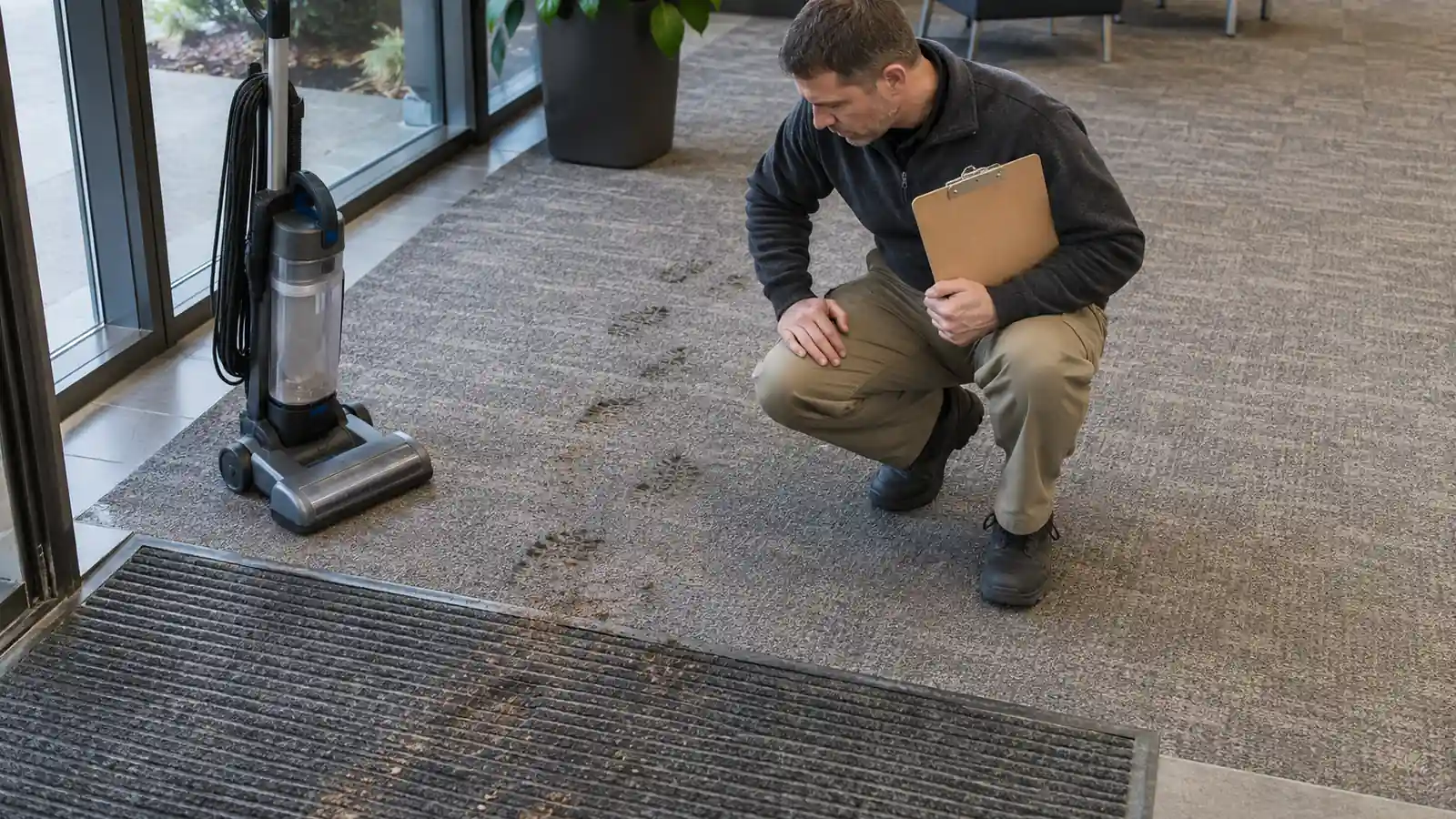
Holiday crowds do not soil a building evenly. Entrance lanes may collect grit and moisture, beverage stations may develop isolated spots, and low-use offices may need little more than routine vacuuming. Treating the entire floor as one cleaning job can waste time while leaving the busiest routes under-served.
A useful post-holiday commercial carpet maintenance reset begins with a condition map. Facility and property managers can then assign the right response to each zone: routine care, targeted spot treatment, interim cleaning, planned deep cleaning, or repair.
Map the Building Before Booking a Full-Floor Cleaning
Inspect the carpet after holiday displays, temporary furniture, and floor coverings have been removed. The carpet should be dry and viewed under normal lighting so damp fibers, shadows, and pile direction do not distort the assessment.
Walk the same route visitors followed:
- Start at each exterior entrance.
- Inspect walk-off mats and the first carpeted section.
- Continue through lobbies, reception areas, elevator landings, and corridors.
- Check turning points, queue lines, beverage stations, and shared seating areas.
- Finish in lower-traffic offices, meeting rooms, and storage areas.
Classify what you find before assigning work:
| Observed condition | Likely maintenance category | Appropriate next step |
|---|---|---|
| Loose grit or dry debris | Routine soil removal | Vacuum thoroughly and reset mat care |
| One recent food or drink spot | Localized spot response | Identify the material and use a compatible treatment |
| A dull lane that remains after vacuuming | Accumulated traffic soil | Evaluate interim or deep cleaning |
| A dark area that changes when viewed from another direction | Pile direction or texture change may be involved | Reassess after cleaning and complete drying |
| An open seam, tear, ripple, burn, or loose section | Physical damage | Request a repair assessment |
| Unexplained dampness or recurring musty odor | Possible moisture-source problem | Identify the source before ordinary cleaning proceeds |
This map turns a vague request to “clean the carpet” into a work order that can be checked after completion.
Reset Entry Lanes as a Connected System
The entry is not just the first few feet of carpet. It is a connected route that includes exterior scraping surfaces, interior mats, hard-floor transitions, lobby carpet, and the paths leading deeper into the building.
Begin by removing dry soil. Vacuum mats and carpet using equipment appropriate for the installed product, following the carpet manufacturer’s guidance on brushes, pile lifting, and maintenance methods. Clean, exchange, or replace mats that are overloaded or damaged. A dirty mat can release soil into the very area it is meant to protect.
Also inspect adjacent hard flooring. Cleaner residue, moisture, and tracked material from tile or resilient flooring can cross the transition and create a narrow, recurring carpet lane. Correcting the upstream source may reduce how quickly the entry carpet becomes dull again.
Turn Each Spot Into a Maintenance Record
After a busy holiday period, several similar-looking marks may have different causes. Coffee, cooking oil, sugary drinks, tracked mud, adhesive, and unknown residue should not automatically receive the same product or technique.
For every significant spot, record:
- Exact location
- Date discovered
- Suspected substance, if known
- Product and dilution used
- Treatment performed
- Appearance after the area dries
- Whether the spot returned
Remove loose solids carefully and blot liquids instead of aggressively rubbing the carpet. Follow the carpet and cleaning-product manufacturers’ instructions, including any pretesting requirements. Adding extra chemical or moisture can leave residue, distort the pile, spread the material, or complicate later professional treatment.
When a spot returns after drying, pause before repeating the same process. The cause may involve remaining cleaning residue, material that moved back toward the surface during drying, or contamination below the visible pile. The treatment record gives cleaner and better information than another untracked application.
Match the Cleaning Level to the Condition
The holiday date explains when the extra traffic occurred, but it does not determine the required cleaning method. Industry guidance separates routine maintenance, interim cleaning, and deep cleaning because they solve different problems.
| Maintenance level | Best fit | Planning considerations |
|---|---|---|
| Routine care | Loose dry soil, functional mats, and minor fresh spots | Vacuuming, mat care, prompt spotting, and routine inspections |
| Interim cleaning | Concentrated traffic lanes need appearance improvement between deep cleanings | Product-approved method, access control, and operational timing |
| Deep cleaning | Embedded soil or broader buildup remains after routine and interim work | Pre-inspection, suitable method, drying time, ventilation, and reopening plan |
| Repair or replacement assessment | Carpet is torn, loose, rippled, separated, burned, or materially worn | Secure the affected area and evaluate the construction and damage |
There is no single federal cleaning interval that applies to every facility. The EPA advises following the carpet manufacturer’s recommendations and relevant industry standards rather than treating a widely repeated frequency chart as an official EPA schedule.
Review the maintenance guide and warranty for the carpet actually installed. Construction, traffic level, color, soil exposure, prior treatments, and the building’s operating hours can all affect the plan. Deep cleaning should be scheduled with enough time for the carpet to dry according to the applicable product and service guidance before normal traffic resumes.
Separate Removable Soil From Physical Damage
Peak traffic can reveal existing defects without being their sole cause. A dark path may contain embedded soil, but it may also include crushed pile, abrasion, color change, or missing fiber. Cleaning addresses removable material; it does not reconnect a seam, flatten a ripple, replace a damaged tile, or recreate fiber that has worn away.
Commercial carpet repair should be considered when an inspection identifies:
- Open or frayed seams
- Tears, holes, or burns
- Ripples or loose broadloom carpet
- Lifted edges or transitions
- Individual carpet tiles that are loose or damaged
- Localized damage that remains after the area is clean and dry
Coordinate the cleaning and repair scopes before work begins. Depending on the defect and carpet system, repair may need to occur before cleaning, after cleaning, or as part of a separate access window.
For help determining the next step, review our commercial cleaning services and carpet repair services. Share the traffic map, spot records, installed carpet information, and any operational restrictions when requesting an assessment.
Convert the Reset Into the Next Maintenance Cycle
- Do not close the holiday cleanup with only a completion date.
- Preserve what the building reveals so the next peak period is easier to manage.
- Update the floor plan with heavy, moderate, and light traffic zones.
- Mark recurring spots, pivot points, and entry lanes.
- Record which areas received routine, interim, deep-cleaning, or repair work.
- Photograph recurring conditions from consistent positions.
- Confirm who owns mat care, spot response, inspections, and service scheduling.
- Review results after the carpet is completely dry and back in normal use.
- Adjust the next maintenance cycle according to observed conditions and manufacturer guidance.
The goal is not to deep clean every square foot simply because the holidays ended. It is to restore the areas that need attention, identify damage that cleaning cannot correct, and carry better information into the next high-traffic period.
Frequently Asked Questions
No. The decision should be based on soil load, traffic patterns, spot history, routine maintenance, carpet construction, and manufacturer guidance. Some zones may need deep cleaning while low-use rooms need only vacuuming.
Inspect promptly after temporary decorations and furniture are removed. Early inspection helps identify fresh spots and loose soil, but final appearance decisions should wait until any damp or recently cleaned carpet has dried completely.
Interim cleaning can improve heavily used lanes between deep cleanings, but it serves a different purpose. Whether it can postpone deep cleaning depends on the carpet, soil conditions, maintenance history, and manufacturer’s instructions.
Remaining embedded soil is one possibility, but pile direction, crushed texture, wear, residue, or color change may also affect the appearance. Compare the lane from different directions and reassess it after complete drying.
Record the location, discovery date, suspected substance, product and dilution used, treatment method, dry result, and whether the spot returned. Photographs can also help document recurring conditions.
Repair deserves consideration when the carpet has open seams, tears, burns, ripples, loose edges, holes, or damaged sections. Repeating a cleaning process will not correct those physical defects.
It depends on the defect and construction. An unstable seam, loose edge, or ripple may need attention before cleaning, while a patching decision may be easier after surrounding soil has been removed. Have the cleaning and repair scopes coordinated before work starts.
Confirm access restrictions, ventilation, drying expectations, and inspection responsibilities before service. Reopen each treated zone according to the carpet manufacturer’s and service provider’s guidance rather than relying on one universal drying time.