


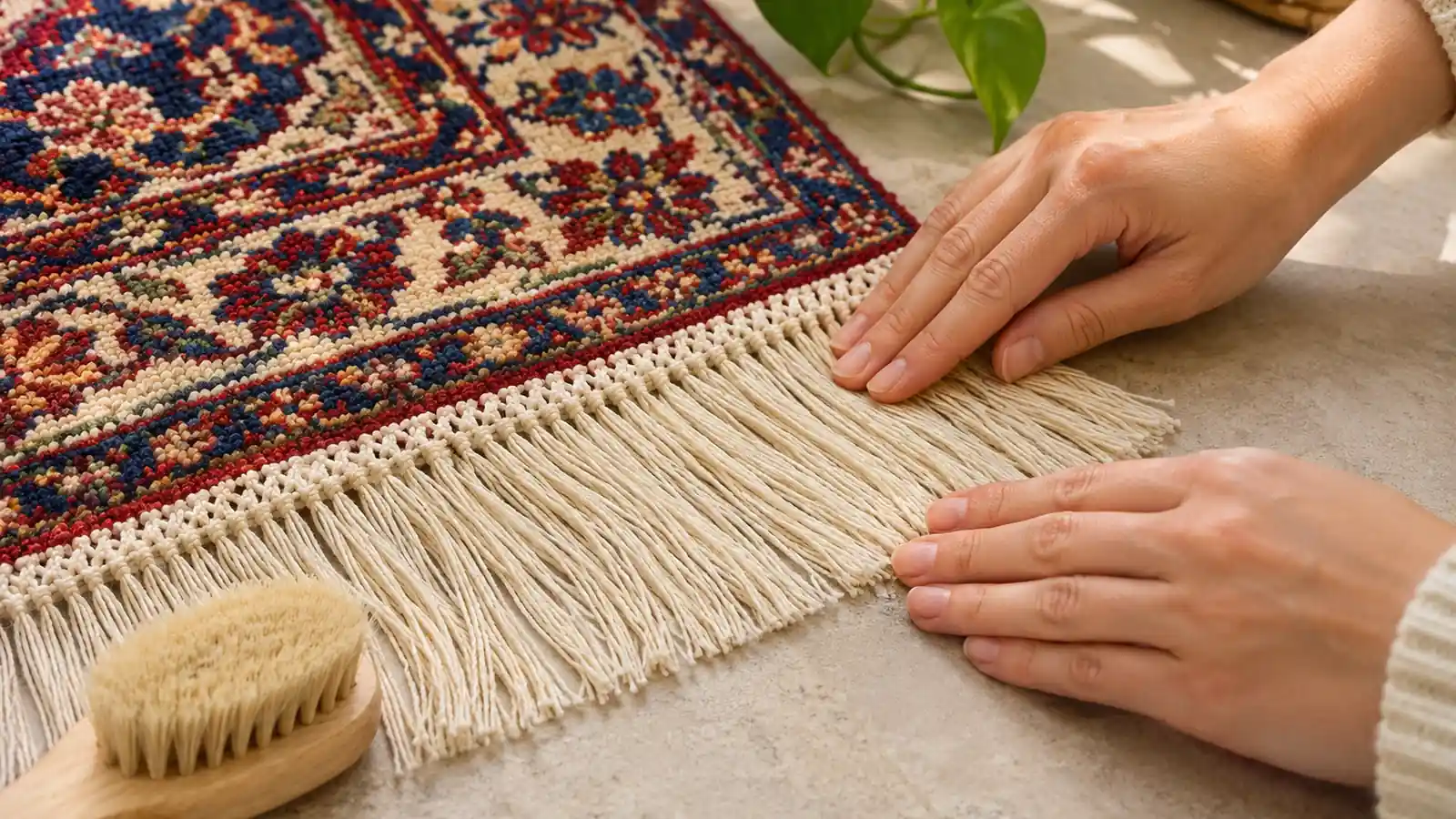
Holiday gatherings can leave a narrow gray line along the rug fringe where shoes, chair legs, crumbs, and repeated foot traffic meet the rug. That line is easy to mistake for a simple whitening job. In reality, it may contain loose grit, an adhered spill, age-related discoloration, or worn fibers, and each condition calls for a different response.
Safe rug fringe cleaning begins with a limit: remove only dry, loose soil from fringe that is sound enough to handle. If the color remains or the threads show damage, more force is not the answer.
First, classify the fringe, the soil, and the condition
Three separate questions determine the next step: how the fringe is constructed, what is making it look dirty, and whether the fibers are stable. Skipping any one of them can turn routine surface care into damage.
On many hand-knotted rugs, the fringe is formed by warp yarns that run through the rug’s foundation. On other rugs, fringe may be attached as trim. You do not need to pull the end apart to decide which you have. Check the care label and purchase information, look at both sides without tugging, and treat an unknown, handmade, or valuable rug conservatively.
| What you observe | What it may mean | Appropriate next step |
|---|---|---|
| Dry crumbs, dust, or grit that shifts easily | Loose surface soil | Use cautious dry removal if the fringe is sound |
| A gray or matted area that stays after loose particles are gone | Bound soil, wear, or discoloration | Stop rather than increasing suction or scrubbing |
| A sticky area, drink mark, odor, or previous water exposure | Soil that dry vacuuming cannot resolve | Arrange rug-specific assessment before adding a cleaner |
| Shortening strands, broken threads, shedding, gaps, or an opening near the rug end | Structural wear or prior damage | Address stability before cosmetic cleaning |
| Color transfer or a history of bleeding | Unstable dye may be present | Do not wet-clean the area at home |
This classification keeps the goal realistic. Removing grit is maintenance; changing a stain, yellowing, or age-darkened fiber is a treatment decision.
Why more scrubbing can make the result worse
Tracked grit is not harmless. Hard particles can abrade textile fibers as people continue walking across them. Yet the cleaning action can also create wear if a rotating brush catches strands or if pressure rubs particles through the fibers.
Moisture adds another layer of uncertainty. Rug fibers, dyes, previous repairs, and cleaning residues do not all respond to water or detergent in the same way. Even a colorfastness test is not a guarantee that wet cleaning will be safe. This is why a home method for loose dry soil should not quietly become a stain-removal or whitening recipe.
Remove loose dry soil with the least practical force
Use this sequence only when the fringe is dry, intact, and permitted to be vacuumed under the rug maker’s care instructions. The purpose is controlled soil reduction, not a bright-white finish.
- Pause traffic and inspect both ends. Lay the fringe flat without pulling it. Look for breaks, detached strands, brittle fibers, open areas near the rug body, old repairs, or dye movement.
- Clean the surrounding floor first. This prevents grit under the fringe from being drawn back into the yarns. Lift and support the rug edge rather than pulling on the fringe.
- Disable the rotating brush or beater bar. Keep a powered floor head away from loose ends. Use the lowest effective suction and a clean suction-only attachment.
- Control the fringe before applying suction. For delicate but stable fringe, a clean mesh screen with smooth, bound edges can keep strands from entering the nozzle. If you cannot position it without snagging threads, stop.
- Lift soil instead of rubbing it in. Hold the nozzle above the protected fringe so suction removes particles without lifting the textile. Reposition it in small sections. Do not scrub, drag the nozzle back and forth, or vacuum across loose ends.
- Stop at the first sign of movement or damage. Twisting, lifting, shedding, snapping, or movement at the rug end means the method is applying too much force or the fringe is not stable enough.
- Reassess after loose soil is gone. Remaining gray, yellow, or brown color is not permission to add bleach, peroxide, vinegar, baking soda, shampoo, or more pressure. Its cause has not yet been established.
Know when cleaning has become a different job
Some post-holiday conditions need inspection rather than another household product. That is especially true when appearance and structure have changed together.
Pause home cleaning when you notice:
- A spill, oily mark, pet accident, odor, or damp area.
- Dye on a cloth, floor, pad, or neighboring fringe strand.
- Silk, brittle fibers, an antique or heirloom rug, or unknown construction.
- Tight tangles that will not separate with light handling.
- Missing fringe, a separating end finish, or visible loss near the last row of pile.
- A previous repair, bleaching attempt, or cleaning treatment you cannot identify.
Williams Carpet Care offers area rug cleaning and Oriental rug cleaning. For a fragile or structurally important rug, describe the material if known, the spill or prior treatment, and any shedding, dye transfer, or broken threads so the condition can be considered before cleaning.
Prevent the next soil line without hiding damage
Once the fringe is stable and loose soil has been removed, reduce repeat exposure instead of covering the problem. Vacuum the adjacent hard floor, keep rotating vacuum parts away from the fringe, and follow the rug maker’s placement and care directions.
After the next busy gathering, compare both rug ends in good light. A small amount of loose soil calls for gentle maintenance. A shortening fringe, a widening gap, or discoloration that survives dry removal calls for evaluation. That clean-versus-stop boundary protects the rug more reliably than chasing a whiter-looking edge.
Frequently Asked Questions
Stable fringe may tolerate careful, low-suction cleaning when the manufacturer permits it. Keep rotating brushes and beater bars away, prevent loose ends from entering the nozzle, and stop if any strand lifts, twists, or sheds.
Vacuuming removes loose particulate soil. A remaining gray area may involve bound soil, oily residue, wear, age-related color, or a previous treatment. More suction cannot identify the cause and may stress the fibers.
Do not treat bright white as the default target. Fringe fibers may be naturally off-white, aged, dyed, previously treated, or weakened. Generic bleach or whitening recipes are not appropriate without identifying the material, dyes, and condition.
Do not force a comb through tight tangles. Lightly arranging sound strands is different from pulling through knots or matted fibers. If the tangle resists or the fibers feel brittle, leave it for rug-specific assessment.
Blot fresh liquid gently with a clean absorbent cloth and avoid rubbing. Because water, cleaning solutions, and dyes can interact unpredictably, do not turn the spot into a soaking or whitening experiment, especially on handmade or valuable rugs.
Broken, shortening, shedding, or missing strands and an opening near the rug end are condition issues first. Cleaning may remove soil, but it does not rebuild lost fibers or stabilize an opening structure.
Use condition and traffic rather than a fixed calendar. Inspect after busy periods and remove loose dry soil only when the fringe is stable. Frequent aggressive cleaning can be more harmful than leaving a minor color difference alone.
Not automatically. Fringe can be part of a woven foundation or attached decoration, and fiber and care instructions vary. Follow the rug maker’s guidance and use the more conservative approach when construction is unknown.