


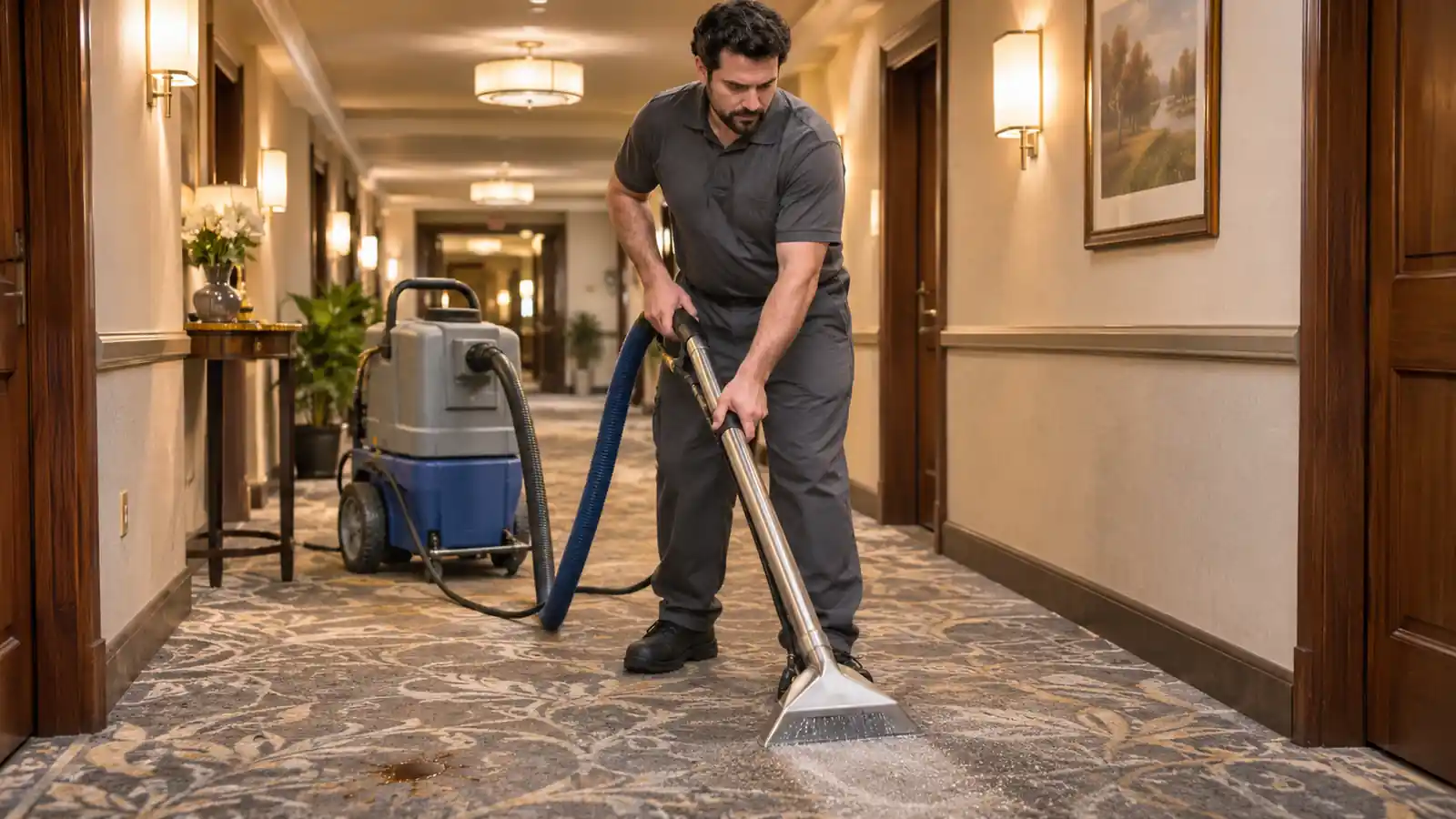
Peak guest traffic does not leave one uniform carpet problem behind. A breakfast spill may sit a few feet from wheel marks, while the center of a hallway looks darker because soil, pile direction, and physical wear overlap. Calling all three conditions “dirty carpet” can lead to the wrong scope and unrealistic expectations.
A useful hotel carpet cleaning closeout works like an after-action review. It records what happened, where traffic carried it, what changed after cleaning and drying, and what did not respond. That evidence helps the hotel choose localized treatment, a connected-zone reset, broader restorative work, or a repair review without putting every room on the same schedule.
Close the Peak Period With Three Evidence Layers
The hotel already has much of the information needed to define the work. The key is to combine operational records with a physical inspection instead of relying on the darkest photograph or the total room count.
Build a spill incident layer
- Create one list of known food and drink incidents.
- Record the location, likely substance, approximate time, and any spot product or equipment already used.
- A coffee mark treated twice and a fresh sauce spill may look similar but present different treatment histories.
The Carpet and Rug Institute advises prompt response, careful removal of loose food, blotting liquids with clean white absorbent material, and avoiding scrubbing that can fray or distort carpet.
Product and method choices should still follow the carpet manufacturer’s instructions. No carpet is completely stain-proof, so the incident log supports realistic expectations rather than a removal guarantee.
Add a rolling-traffic layer
- Trace where luggage, housekeeping carts, event equipment, and delivery wheels moved most often.
- Focus on entrance transitions, check-in approaches, elevator thresholds, hallway turns, ice or vending areas, and routes serving breakfast or meeting spaces.
Wheel paths do not prove that every dark mark came from luggage. They show where dry grit, damp entry soil, and residue may have been transported or concentrated. That distinction matters because loose dry material should generally be removed dry first, using equipment permitted for the carpet construction.
Establish a surface-condition layer
- Compare busy lanes with carpet near walls, beneath movable items, or in lower-use sections of the same installation.
- View a hallway from both directions.
- Note whether the surface looks dark, light, flat, tangled, frayed, sparse, discolored, loose, or rippled.
- A photo records appearance; it does not, by itself, distinguish removable soil from pile change or damage.
CRI explains that pile reversal can change how light reflects and may create a lasting dark-or-light appearance. The IICRC S100 standard includes pre-cleaning inspection, carpet characteristics, soil management, and method selection within professional textile-floor care.
Separate Recoverable Soil From Appearance Change
Once the three evidence layers are combined, classify each marked area before setting the scope.
| Observed condition | Evidence to check | What cleaning may address | What cleaning cannot promise |
|---|---|---|---|
| Localized food or drink mark | Incident time, substance, prior products, change after drying | Loose material, compatible spot treatment, and removable residue | Complete removal of every stain or color change |
| Entry or luggage-route soil | Dry grit, wheel pattern, adjoining hard floor, entrance-mat condition | Dry soil and compatible treatment for remaining bonded soil | Correction of damage caused by long-term abrasion |
| Dark or light hallway lane | Viewing direction, protected comparison area, response after dry-soil removal | Soil or residue contributing to the appearance | Permanent correction of pile reversal or missing fiber |
| Loose seam, shifted tile, ripple, or frayed yarn | Location, extent, matching material, backing or edge condition | Soil around the damaged area | Structural repair through deeper cleaning |
This classification also keeps a cleanable condition from being sent straight to replacement review, while preventing repeated cleaning from being sold as a remedy for physical wear.
Run the Recovery in Three Passes
The sequence matters because moisture and fresh traffic can hide what the hotel needs to learn from the post-peak condition.
1. Complete the dry assessment
- Inspect and photograph priority areas before adding moisture.
- Remove loose dry soil where the manufacturer permits, then reassess the lane.
- Mark spills, recurring spots, edges, seams, transitions, and turning points separately.
- This creates a baseline for judging whether later work changed the condition.
2. Match scope to both condition and access
Choose among a localized spill response, cleaning of connected high-use zones, broader restorative cleaning, or repair and replacement review. Manufacturer guidance, carpet construction, soil load, prior products, appearance expectations, and the available operating window can all affect the appropriate method.
At the same time, confirm the exact rooms and corridors in scope, equipment and water access, security and noise limits, guest detours, barriers, ventilation, and the route that must remain available. A technically suitable method is not an operational plan until those constraints are settled.
3. Verify after full drying
- Return to the same marked locations after the carpet has fully dried.
- Photograph them from the same direction, compare them with the baseline, and record whether the issue was removed, improved, unchanged, or returned.
Drying time varies with carpet construction, cleaning method, moisture recovery, airflow, temperature, humidity, and soil level. Reopening should follow actual dryness and applicable manufacturer requirements, not a fixed promise. Traffic on damp carpet can contribute to rapid resoiling.
Let the Closeout Record Set the Next Scope
The completed record should point to a specific next action rather than a hotel-wide frequency copied from another property.
- Close the incident when a contained spill responds, and the surrounding carpet remains stable.
- Adjust routine care when dry soil repeatedly collects at a mat, threshold, elevator landing, or turn.
- Plan connected-zone work when the same soil pattern continues across adjoining guest routes.
- Escalate the condition when a mark returns, pile appearance remains changed, or seams, tiles, backing, or fibers show damage.
The post-peak objective is not to make every square foot follow one cleaning calendar. It is to close the record on each spill, transport path, and appearance change, then carry unresolved conditions into the right maintenance, repair, or replacement decision.
For a Fayetteville property, we can assess commercial carpet cleaning in Fayetteville, NC around the carpet condition and operating window. We provide commercial carpet cleaning and select cleaning methods according to the job; hotel-specific scope, access, and scheduling should be confirmed during the assessment.
For more detail on the soil-versus-wear distinction, see our high-traffic carpet cleaning guide.
Frequently Asked Questions
There is no reliable interval for every hotel or every zone. Base the schedule on manufacturer guidance, carpet construction, traffic, soil and spill patterns, appearance expectations, prior maintenance, and available drying windows. Entrances and elevator approaches may need attention sooner than lightly used rooms.
It may improve lanes caused by removable soil or residue. It cannot rebuild worn fibers or permanently correct every change in pile direction, matting, abrasion, or color. Inspect the lane from different directions and compare it with a protected area before setting expectations.
No. Scrubbing can spread the spill and distort the carpet pile. Remove loose solids carefully and blot liquid with a clean white absorbent cloth. Follow the carpet manufacturer’s instructions and record any cleaning product used.
No. Loose, dry grit should generally be removed dry first with equipment suitable for the carpet. After vacuuming, reassess whether bonded soil, oily residue, spots, or broader buildup remains and whether interim or restorative cleaning is appropriate.
Not automatically. Corridors, elevator landings, entrances, guest rooms, breakfast areas, and meeting spaces receive different traffic and soil. Use zone conditions rather than applying one frequency to the entire property.
Work may be phased by area when the property, contractor, and carpet requirements allow it, but access cannot be assumed. Confirm guest routes, emergency access, noise limits, barriers, ventilation, and drying before scheduling.
There is no universal drying time. Carpet construction, cleaning method, moisture recovery, airflow, temperature, humidity, and soil level all matter. Reopen the area according to actual dryness and applicable manufacturer guidance.
We provide commercial carpet cleaning in Fayetteville. A hotel should contact us to confirm that its carpet type, areas, access needs, operating window, and requested scope can be accommodated; the service listing alone does not establish availability for every property or system.