


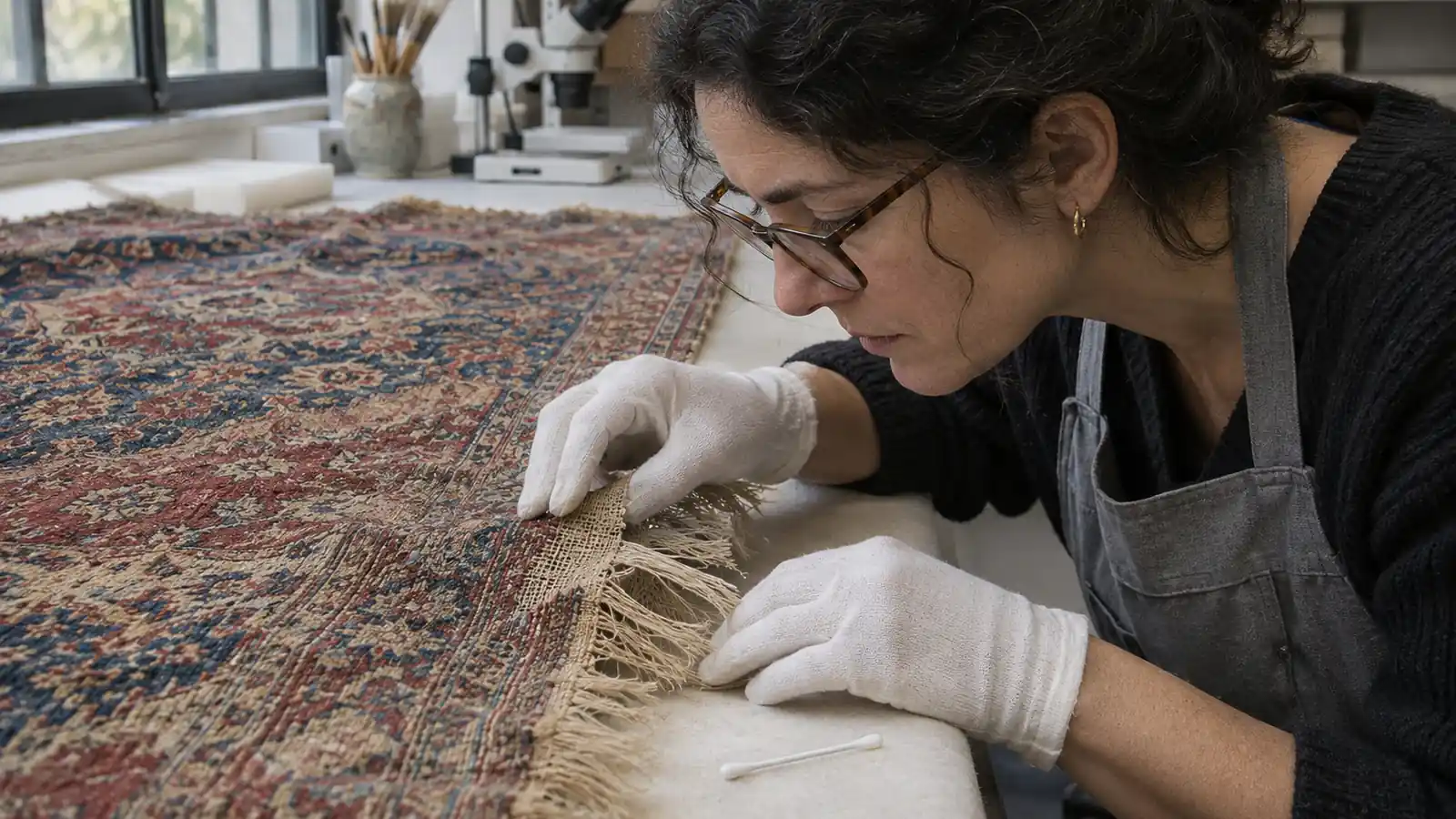
The number of years behind an antique rug is less useful than what happened during those years. A sharp storage fold, brittle fringe, old repair, or dye movement around a spill can matter more than the date assigned to the piece. That is why antique rug cleaning should begin with recent history and present condition, not a standard cleaning recipe.
The decision is not simply old versus new. It is stable versus vulnerable. Light, moisture, foot traffic, storage pressure, previous treatments, and repairs may have changed what the dyes and threads can tolerate.
After a spill or long storage, the first job is to learn what happened before deciding whether the rug should be moved, surface-cleaned, wet-cleaned, stabilized, or referred for conservation.
Reconstruct the Event Before Touching the Rug
A fresh spill and a rug returning from storage create different risks. A short event record gives the cleaner or conservator information that the rug cannot reveal by appearance alone.
After a spill
- Record the liquid or material involved, when it happened, how far it spread, and every product or method already used.
- Photograph the front, back, edges, and floor beneath the affected area.
- Note whether color transferred to a white absorbent cloth, a ring formed, the texture changed, or an odor returned after drying.
After storage
- Record how long the rug was stored, whether it was rolled or folded, what touched it, and whether the space was damp, hot, or vulnerable to pests.
- Photograph fold lines, crushed areas, holes, loose powder or fibers, insect cases or webbing, stains, tide lines, and changes on the underside.
- Do not discard wrapping until you know whether it transferred color, trapped moisture, or contains pest evidence.
This history separates a cleaning question from a handling, pest, moisture, or structural question. A rug with active dampness, visible growth, a strong unknown chemical odor, or widespread insect activity needs the relevant specialist assessment before ordinary cleaning proceeds.
Read the Surface and the Foundation Separately
The visible pile and the load-bearing foundation do different jobs. A rug may have attractive color and pile while the underlying structure is no longer strong enough for routine handling.
Pile and dyes
The pile creates much of the rug’s color and surface texture. Each color may have a different dye history and response to water or a cleaning solution. Fading is not the same as active dye migration, and a test on one shade does not clear every color, repaired area, or later addition.
The Canadian Conservation Institute explains that colorfastness testing is only one factor in deciding whether a historic textile can be wet-cleaned; a negative test is not a guarantee. Existing color bleed, very fragile material, composite construction, and other conditions may rule out washing altogether.
Foundation, edges, and fringe
In many hand-knotted rugs, the pile is tied around warp threads and held by crosswise weft threads. Those warp and weft elements form the foundation. The visible fringe may continue from the warp, while edges help secure the sides. Materials vary, so construction should be identified rather than assumed.
Long folds concentrate stress in narrow lines. Storage pressure, abrasion from embedded grit, insects, moisture, old repairs, and repeated flexing can weaken foundation threads. A cleaner-looking surface cannot compensate for a foundation that splits when lifted or tensioned.
| What you observe | What it may change |
|---|---|
| Color on a white cloth or bleeding into a neighboring area | Stop adding moisture; dye behavior needs evaluation |
| A sharp fold, cracking sound, split, or exposed foundation | Support the rug and limit flexing before cleaning |
| Powder, loose fibers, webbing, cases, or irregular holes | Isolate the rug and assess possible pest activity |
| Musty odor, tide lines, or dampness underneath | Investigate moisture before wrapping or cleaning |
| Stiff, sticky, faded, or distorted spill area | Document prior products and treat it as more than loose soil |
What to Do Immediately After a Spill
The goal of the first response is to remove excess liquid without spreading it or adding a second chemical problem.
- Keep people and pets off the affected area.
- Lift solids gently without scraping through the pile.
- Blot with clean, white absorbent material; do not rub or scrub.
- Replace the absorbent material as it becomes wet and note any color transfer.
- Stop if the pile distorts, threads loosen, color moves, or you are unsure about the spill or rug material.
- Do not pour cleaner onto an antique rug or work through a series of household formulas.
- More liquid can enlarge the affected area, move dye, carry residue into the foundation, or make the eventual treatment harder to interpret.
The Institute of Conservation advises that handmade rugs are not candidates for ordinary modern-carpet shampoos or steam-cleaning assumptions; suitability for wet cleaning depends on condition, composition, and dye stability.
How to Open a Rug After Storage
A stored rug needs a condition check before normal vacuuming or use. Give yourself room to support it and capture any loose material.
- Move the rug with help if its size or condition makes it awkward; do not drag it by an edge.
- Unroll or unfold it slowly on a clean, dry support without forcing a stiff crease flat.
- Inspect the wrapping, front, back, fringe, and floor for moisture, staining, loose fibers, and pests.
- Keep fragments, labels, and detached threads with the rug rather than discarding them.
- Vacuum only if the rug is stable enough. Use low suction, avoid rotating agitation, protect fragile areas with a screen, and stop if fibers or threads lift.
Textile storage guidance favors rolled storage over sharp folds because folds create concentrated weak areas. The correct rolling direction and support can depend on whether the pile, foundation, or an added lining is more vulnerable. A recently discovered antique rug should therefore be assessed before it is tightly rerolled for another season.
What Specialized Cleaning Should Decide
Specialized care is not one gentler machine setting. It is a series of decisions about what the individual rug can safely tolerate and what outcome is realistic.
Is the rug stable enough to clean?
Inspection should cover the front and back, foundation, fringe, edges, holes, fold lines, brittle areas, previous repairs, and the spill or storage zone. Stabilization or repair may need to come before cleaning. Some rugs may need conservation-led treatment rather than a routine service.
How should the dyes and fibers be evaluated?
Testing should address each relevant color and any visibly different repair yarns or painted areas. Fiber identification matters too. When comparing a silk rug cleaning service, ask what evidence supports the fiber identification, how dye movement and texture risk are evaluated, and how the provider decides when not to wet-clean.
Which cleaning and drying approach fits the evidence?
The method should respond to the soil, spill chemistry, construction, dye behavior, structural strength, and prior treatments.
Dry-soil removal, localized treatment, controlled washing, limited-moisture work, stabilization, or no cleaning may each be appropriate in different circumstances. Drying must also support the rug evenly and control shape and color movement; “antique” is not a single method category.
For general preparation before service, our guide to Persian rug cleaning considerations explains why inspection and dye behavior matter.
If you need an individual scope review, we can discuss whether our Oriental rug cleaning service fits the rug’s material, condition, and spill or storage history. Confirmation should come before treatment, especially for silk, antique, repaired, or historically significant pieces.
Preserve the Evidence Before Trying to Improve the Appearance
The most useful rule after a spill or storage discovery is to slow down. Blot a fresh liquid without rubbing. Support a weak rug instead of testing its strength by lifting an edge. Record the storage and treatment history. Then let dye stability and foundation condition determine the next step.
Good antique rug cleaning does not begin by asking how aggressively a mark can be removed. It begins by asking which parts of the rug are still stable, what changed during the event, and which treatment preserves the most material while addressing the actual soil or stain.
Frequently Asked Questions
Can I clean a drink spill on an antique rug myself?
- Limit first response to removing solids gently and blotting excess liquid with clean, white absorbent material.
- Do not scrub or add an unfamiliar cleaner.
- Color transfer, texture change, loose threads, or uncertainty about the fiber are reasons to stop and seek an assessment.
Is one colorfastness test enough for an antique rug?
No. Different colors, repair yarns, painted areas, and later additions may behave differently. Even a test with no visible transfer is not a guarantee that the entire rug can be wet-cleaned safely.
Why can the foundation be weak when the pile still looks good?
The pile and foundation have different materials and stresses. Fold pressure, embedded grit, insects, moisture, old repairs, and repeated flexing may weaken warp or weft threads without producing an obvious surface hole.
Can cleaning remove a fold line from storage?
It depends on whether the line is a temporary distortion or structural damage. Forcing a brittle crease flat can cause a split. The rug should be supported and assessed before anyone promises that cleaning or blocking will correct it.
Should I vacuum an antique rug as soon as it comes out of storage?
- Inspect it first.
- If fibers are powdered, threads are broken, fringe is loose, or pest evidence is present, ordinary vacuuming can remove original material or spread a problem.
- Stable rugs may tolerate low-suction surface cleaning with appropriate protection.
Is every silk rug too delicate for wet cleaning?
No universal answer applies. Fiber condition, construction, dyes, finishes, repairs, and previous exposure all matter. Some rugs may tolerate a controlled process; others should not be wet-cleaned. Examination and testing must come before the method.
What information should I give a rug cleaner?
- Share the spill material and timing, every product used, how the rug was stored, signs of dampness or pests, known repairs, prior cleaning history, and any sentimental, historical, or financial importance.
- Photographs taken before moving or treating the rug are useful.
When does an antique rug need a textile conservator?
Consider conservation advice when the rug is historically significant, fragmenting, powdering, actively bleeding, badly split, contaminated by an unknown substance, affected by visible growth or pests, or too weak for routine handling. Cleaning and conservation can overlap, but they are not interchangeable.