


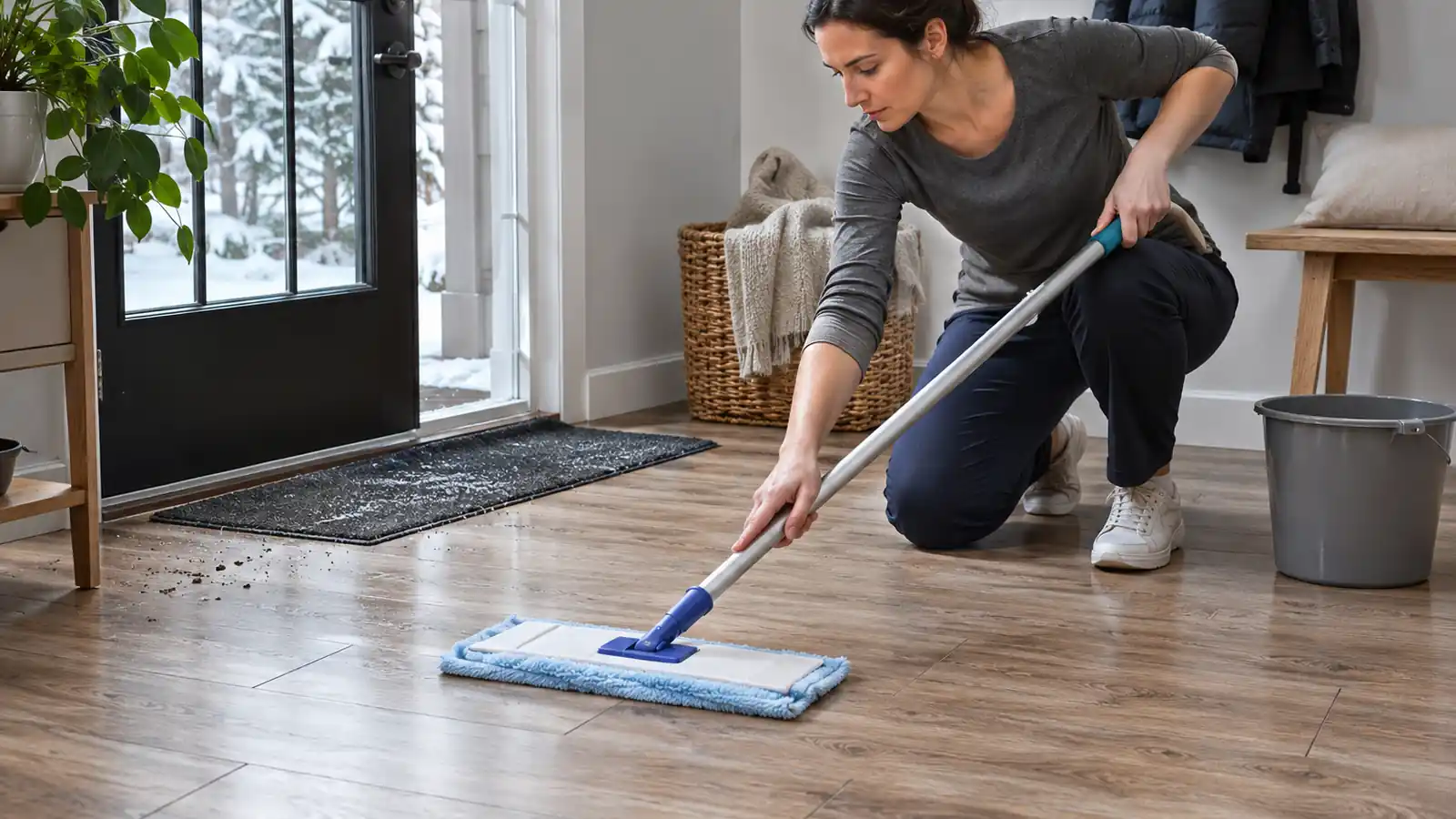
Laminate can resemble vinyl or wood, but its cleaning limits are not interchangeable with either one. Winter adds a second complication: dry grit can abrade the surface, while moisture can dissolve deicer and old cleaning product into a film that settles around plank joints.
That means the safest laminate floor cleaning service is not the one with the strongest machine. It is the one that can show why each tool, liquid, pad, and setting is permitted for the exact floor. The practical rule is simple: permission before power.
“Waterproof” Is Not a Cleaning Method
Marketing labels describe a product feature, not a universal maintenance procedure. Laminate makers publish different rules for damp mopping, steam, powered scrubbers, approved cleaners, and drying.
Shaw’s current laminate guidance requires dry soil removal before limited wet cleaning and warns against standing moisture. Some Pergo laminate instructions permit steam or a compact cleaning machine only for products with a specified wet warranty and only within detailed limits. Other laminate guides prohibit both.
Before accepting “steam-safe,” “waterproof,” or “hard-floor safe” as an answer, match the proposed method to the brand, product line, warranty, and current care guide.
Give Every Method Four Permissions
A finish-protective method needs four separate approvals. Passing one does not compensate for failing another.
Product permission
- First confirm that the floor is laminate rather than LVP, engineered wood, or another wood-look surface.
- Use installation records, a spare carton, retailer records, or the maker’s product identification help.
- If the floor remains unknown, dry cleaning is the conservative holding action while its identity is investigated.
Contact permission
The vacuum head, mop pad, brush, and machine wheels all touch the finish. A hard-floor vacuum should have its rotating beater bar disabled. Pads must be clean, non-abrasive, and replaced before trapped grit turns the cleaning tool into the source of scratches.
Liquid permission
- Confirm the allowed cleaner, dilution, application method, and moisture level.
- A neutral pH does not make an unknown product automatically compatible.
- Oil soap, wax, polish, “shine” additives, and excess detergent can leave a film or conflict with the care guide.
- Liquid should not sit at joints or edges.
Energy and recovery permission
Heat, pad pressure, machine weight, rotational speed, dwell time, and water recovery all matter. If the product guide does not authorize the proposed steam or machine conditions, do not treat the method as approved merely because it works on another laminate.
Clean Winter Soil in Two Separate Passes
Trying to collect grit and dissolve residue in one wet pass increases finish risk. Separate the particle problem from the film problem.
- Contain the entry zone. Pick up loose ice-melt granules and address wet footwear, pet paws, and saturated mats before traffic spreads the material.
- Remove dry particles. Vacuum with an approved hard-floor attachment or use a clean microfiber dust mop. Check wheels and pad faces for embedded grit.
- Inspect the dry floor. Note whether the remaining mark is powdery, tacky, cloudy, scratched, or concentrated at a seam.
- Run a small compatibility test. Use the maker-approved product and the least moisture the instructions require. Apply it to the pad when directed rather than pouring liquid onto the planks.
- Recover and compare. Change dirty pads, remove remaining solution, dry the test area, and compare it with the untreated floor before expanding the process.
Let the Pattern Point to the Next Check
Winter residue is easier to manage when you read where and how it appears. A pattern is not a diagnosis, but it can prevent repeated whole-room mopping while you test the likely cause.
| What you see | Useful clue | Next check |
|---|---|---|
| White granules or haze within the first few feet of an entrance | Tracked deicer, grit, or dried slush | Remove particles dry, then test an approved low-moisture method |
| Curved streaks that follow the mop path | Loaded pad, excess product, or redistributed film | Use a clean pad and verify cleaner dilution |
| Uniform haze across low- and high-traffic areas | Product film or an incompatible shine additive | Review product history and test a small area without adding more cleaner |
| Darkened joints, raised edges, or swelling | Moisture may have reached the plank core or joint | Stop wet work and request flooring-specific assessment |
| Dull traffic lanes that do not change in a controlled test | Abrasion or wear may be more likely than removable film | Avoid polish as a shortcut; discuss repair or replacement options |
Ask a Service to Define the Method Before Arrival
A useful estimate should describe more than “deep cleaning.” Ask the provider to document:
- The identified flooring product and care instructions used
- The winter soil or residue being targeted
- The dry-removal tool and how abrasive contact will be controlled
- The cleaner, dilution, and planned moisture application
- Any machine’s pad, pressure, speed, weight, heat, and recovery method
- The location and success criteria for a test area
- Existing scratches, open joints, raised edges, or other exclusions
- The expected result, including what cleaning cannot change
This creates a checkable plan. If the surface cannot be identified or the proposed method cannot be tied to its care instructions, the whole-floor treatment should wait.
Keep the Entryway From Resetting the Problem
ReadyNC notes that North Carolina winter storms can bring snow, sleet, freezing rain, and icing. Even an occasional event can create a concentrated entryway problem.
- Use an exterior scraper mat and an absorbent interior mat permitted by the flooring maker.
- Remove wet footwear and clean pet paws near the entrance.
- Vacuum the entry path before granules travel farther into the room.
- Clean and dry mats before trapped grit or moisture escapes back onto the floor.
- Wipe up meltwater promptly, especially at thresholds and joints.
The method that protects laminate is the method the floor permits, applied in the right order. Remove winter particles first, test residue removal second, and increase heat, moisture, chemistry, or machine force only when the product instructions authorize it.
Williams Carpet Care offers surface-dependent laminate cleaning in parts of our service area. Ask us about your floor and location so we can confirm whether an appropriate method is available before scheduling.
Frequently Asked Questions
• Do not assume vinegar is compatible.
• Some generic advice recommends it, while multiple laminate guides prohibit acidic or unapproved cleaners.
• Follow the care guide for the exact product and test an approved method in a small area.
Only when the exact flooring instructions expressly permit it. Some products allow steam under narrow conditions, while others prohibit it even when they have moisture-resistant features. Check the warranty for heat setting, pad, direction, exposure time, and joint protection before use.
No. pH is only one property. The cleaner’s ingredients, concentration, residue behavior, and the flooring maker’s approval still matter. Use the exact dilution and application instructions rather than treating “neutral” as blanket permission.
Only when the care guide for that product permits the specific machine conditions. Some guides prohibit powered scrubbers; a limited Pergo guide permits a compact machine under stated weight, speed, pad, pressure, temperature, and recovery limits. The equipment must match the floor, not just the room size.
Cloudiness may come from excess cleaner, a loaded pad, deicer film, or fine scratching. Compare the pattern with the table above, remove grit dry, and test the approved cleaner on a small area. Do not add polish before identifying the cause.
Either can work if the tool does not scratch the floor. A hard-floor vacuum attachment with the beater bar off is useful for lifting particles instead of pushing them. Soft brooms and clean dry microfiber pads can also work, but stop if grit becomes trapped under the tool.
Stop when you see swollen joints, lifted edges, bubbling, delamination, exposed decorative material, or moisture that may have entered beneath the planks. Those signs call for a floor-condition assessment, not repeated wet cleaning.
No universal method fits every laminate. We advertise laminate cleaning as surface- or method-dependent in Fayetteville and Southern Pines. We need to confirm the floor, its condition, the manufacturer’s limits, and service availability for the address before recommending a process.