
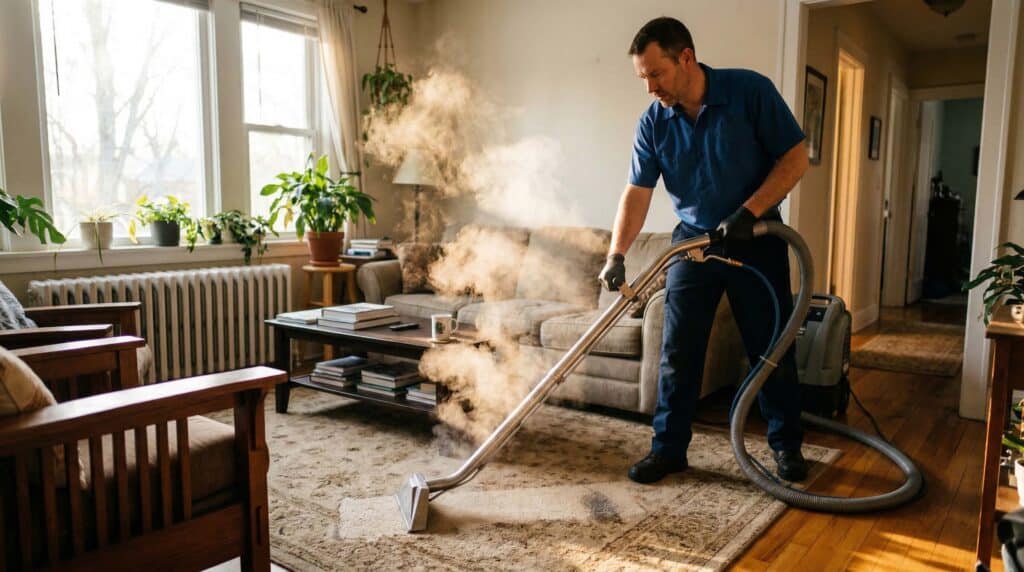
In Sandhills homes, rental properties, and commercial interiors, carpets collect more than visible dirt. Spring pollen, pet dander, tracked-in grit, red clay, rainy-day soil, and everyday foot traffic all settle into the pile. Add humid weather, stale odors, or an overused DIY machine, and the question is no longer just how often you should clean carpet.
It becomes how warm the cleaning process should be, and how much heat is actually helpful before it becomes risky. Carpets, rugs, upholstery, and ducts are places where daily buildup collects, while state climate sources note that the region deals with humidity and very warm summers, which can affect drying and odor control.
Heat helps loosen oily residue and embedded soil, but only when it matches the carpet and the cleaning method.
The best temperature to clean carpets is usually warm to hot water, not cold water, and not near-boiling water. Heat helps break down oily residue, lifts stuck-on grime more effectively, and improves how detergents work during deep cleaning.
That is one reason major carpet-care guidance points homeowners toward professional hot water extraction for periodic deep cleaning instead of relying only on surface-level methods. Shaw Floors carpet care guidance recommends professional hot water extraction as part of routine carpet maintenance, depending on traffic levels.
Cold water can help with certain fresh spills, especially when you are trying to avoid setting a stain. But for general maintenance cleaning, cold water does not cut oily film as effectively and usually leaves more soil behind.
That matters in high-traffic households, office corridors, and pet-friendly homes where carpet fibers hold fine dirt long after the floor stops looking visibly dirty. Regular vacuuming cannot remove everything trapped deep within the fibers.
Too much heat can work against you. Carpet fibers, backings, adhesives, and dyes do not all respond the same way. Synthetic carpet may tolerate more heat than a delicate wool or Oriental rug, but that does not mean every carpet should get the hottest possible setting.
High heat combined with the wrong chemistry, too much moisture, or poor extraction can leave you with distortion, texture change, recurring odor, or a carpet that stays damp longer than it should. That is why the safer standard is controlled heat, not maximum heat.
Fiber type, rug construction, and soil level should shape the cleaning decision.
The most practical answer is that there is no single perfect number for every carpet in every room. Temperature should be chosen based on fiber type, construction, age, soil level, and whether you are cleaning broadloom carpet, a delicate area rug, or upholstery nearby.
Cleaning methods are chosen based on fiber type, construction, and condition, which is exactly how you should think about heat as well.
Many installed residential carpets handle warm-to-hot extraction well when the process is balanced, and recovery is strong. Delicate rugs are different. A handmade, wool, or Oriental rug may need a gentler, fiber-specific approach rather than the kind of temperature and moisture level used on wall-to-wall synthetic carpet.
That is why area rug cleaning and professional carpet and rug cleaning should not be treated as interchangeable, just because both involve soft surfaces.
Temperature also depends on what you are trying to remove. A lightly soiled bedroom may not need the same approach as a family room with pet residue, tracked-in mud, and old spills. Professional guidance on dry vs. wet carpet cleaning recommends that wet cleaning is better for deeper cleaning, while dry methods are more surface-level and faster to dry.
In practical terms, heat matters most when you need a true deep clean instead of a quick refresh.
If your carpet still looks dull after repeated DIY cleaning, smells musty in humid weather, or seems to stay dirty in traffic lanes, a maintenance-led next step is to compare the fiber type, soil level, and dry-time needs before booking the next clean.
For a deeper evaluation of carpet, rugs, or temperature-sensitive materials, Contact Williams Carpet Care right away.
Call 910-476-5459
A carpet is not truly finished just because the visible soil is gone. It also needs to dry well. Higher cleaning temperatures can help loosen soil, but drying depends on airflow, humidity, carpet thickness, and how much moisture was left behind. That point matters in this region because summer heat often comes with humidity, not dry air.
ReadyNC extreme heat guidance says that heat waves often come with high humidity, and the state is humid with very warm summers. That can slow evaporation and make odor control harder if too much moisture remains in the carpet.
Warm water can improve cleaning performance, but a damp carpet in a humid home can still smell stale or feel tacky if drying drags on. Recurring dampness, musty odor, and repeated wet spots are signs that the issue is bigger than a normal surface clean.
That is a reminder that heat only helps when extraction and drying are handled well too.
If you clean during a sticky, humid stretch, indoor airflow matters more. Fans, HVAC circulation, and reasonable indoor temperature can help the carpet dry more evenly. That is also one reason broader home maintenance often overlaps with floor care.
If carpet, upholstery, and air ducts are all carrying seasonal buildup, the room can keep feeling dusty even after a floor cleaning. Ducts collect dust, pollen, pet dander, and other debris that recirculate through the home.
DIY machines can help with upkeep, but temperature mistakes can create bigger problems.
For practical upkeep between deep cleanings, it helps to rotate through maintenance that matches the season and the surface. A spring carpet cleaning checklist is useful when pollen and dust build up.
Carpet cleaning and pets guide is helpful when shedding, stains, and odor are part of the wear pattern.
The takeaway is simple. Heat matters because it improves soil removal, helps detergents work better, and supports deep cleaning. But the best temperature to clean carpets is the one that fits the fiber, the amount of soil, and the drying conditions in the room. Good cleaning is not about using the hottest water possible. It is about using enough heat to clean effectively without creating a new problem.
Warm-to-hot water is usually better than cold water for deep carpet cleaning because it helps break down oily soil and lifts embedded grime more effectively. The exact temperature should still match the carpet type, the cleaning method, and the condition of the flooring. Delicate rugs may need a gentler approach than installed synthetic carpet.
In many cases, yes. Warm or hot water generally helps cleaning agents work better and improves the removal of traffic soil, residue, and stuck-on grime. Cold water still has a place for certain fresh spot issues, but it is usually not the strongest choice for deep maintenance cleaning across heavily used carpeted rooms.
Yes. Too much heat can risk texture change, dye issues, backing stress, or slower recovery if the process is not balanced well. Heat should be controlled, not extreme. That matters even more with older carpet, delicate rugs, and any floor that already shows ripples, loose seams, or wear.
People often use the terms interchangeably, but in practice, the bigger point is that both refer to a deeper clean than basic surface methods. Professional-grade hot water extraction and deep steam cleaning are part of deeper carpet and rug care, especially for embedded dirt and everyday wear.
Absolutely. Wall-to-wall synthetic carpet, area rugs, and Oriental rugs should not all be cleaned the same way. The cleaning approach is chosen based on fiber type, construction, and condition. That is a good rule for temperature decisions too, not just product selection.
Usually because moisture stayed in the carpet too long, or existing residue was not fully removed. Humid weather can make that worse. A carpet that looks cleaner can still hold dampness or trapped odor below the surface, especially in thick-pile, high-traffic rooms and pet-affected areas.
Not necessarily. Warm weather can help, but high humidity can slow drying. The better question is whether the room has enough airflow and whether the method leaves behind too much moisture. A balanced cleaning process with good extraction often matters more than the season alone.
Pet homes often need deeper cleaning because of odor, tracked-in dirt, and repeated soil load in the same areas. That can make warm-to-hot extraction more useful than low-moisture touchups. Still, you should match the process to the carpet and avoid assuming that more heat automatically solves odor problems by itself.
No. Area rugs, especially delicate or valuable ones, often need a more fiber-specific method. Rug care depends on the material and construction. A one-size-fits-all approach is more likely to create color, texture, or moisture problems on specialty rugs.
If the carpet looks wavy, rippled, or loose after repeated use, humidity shifts, or age, cleaning may not fix the core problem. A stretched or repaired carpet can respond better to future maintenance because the surface lies flatter and dries more evenly than a buckled or uneven one.
The best schedule depends on soil load, pets, children, entryway traffic, and how the room is used. Manufacturer guidance commonly points to periodic hot water extraction, while routine maintenance plans are great for homes and commercial interiors. High-traffic spaces usually need attention sooner than lightly used rooms.
Indirectly, yes. Temperature affects how well deep cleaning removes built-up soil, but indoor-air comfort also depends on what else is in the room. Carpets, upholstery, and ducts can all hold dust, pollen, and dander. If the space still feels stale after a floor cleaning, broader maintenance may be worth considering.