
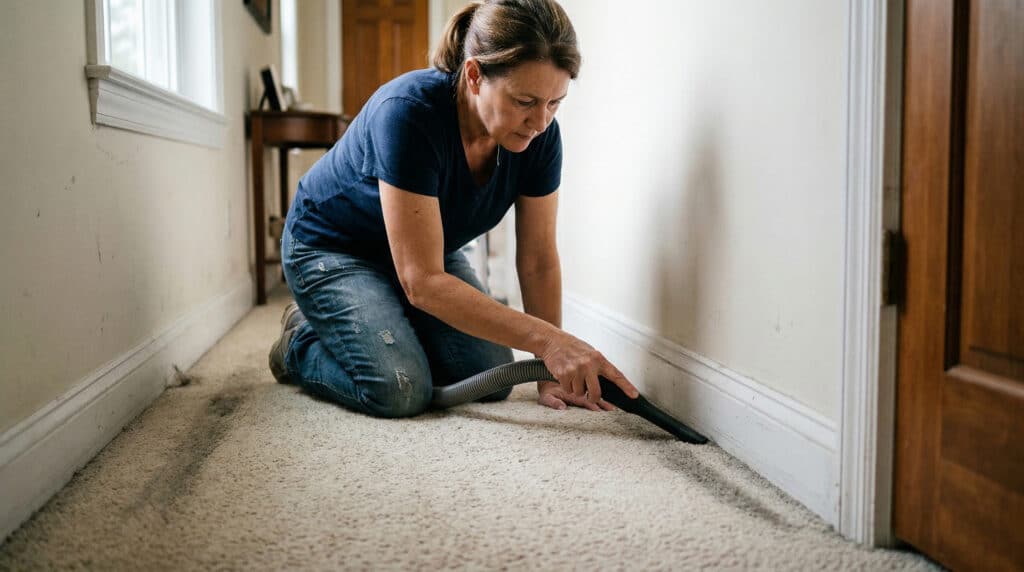
In busy homes, rental properties, offices, and mixed-use interiors, carpet does not just collect visible dirt from shoes and pets. It also catches fine particles that move through the air every day. That is one reason black lines can show up along walls, under doors, around vents, or at stair edges, even when the main walking areas do not look especially dirty.
Those dark marks are commonly called filtration lines or filtration soiling, and they tend to develop where airborne particles repeatedly pass through or settle into carpet edges.
These marks are usually an airflow and particle problem, not just a vacuuming problem.
Black carpet edges are often caused by very fine dust and airborne particles collecting where air is forced through tight gaps or along room perimeters. That is why the lines often appear next to baseboards, beneath doors, near transition strips, and around vents instead of in the center of the room.
EPA says that indoor pollution sources that release gases or particles are a primary cause of indoor air-quality problems in homes, and fine particulate matter can come from multiple indoor sources.
Traffic soil usually builds up where people walk. Black edge lines form where air movement deposits tiny particles into the carpet. They often look narrow, dark, and concentrated along room edges rather than spread across the whole floor.
When air escapes through small gaps at the wall-to-floor edge or under a closed door, the carpet can trap dust, soot, smoke residue, and other fine particles. Over time, that repeated filtering effect darkens the fibers near those openings.
Routine vacuuming matters, but it does not always reach the place where the problem starts.
Dirt, allergens, stains, and odors can settle deep within carpet fibers, and regular vacuuming cannot remove everything trapped there. That limitation matters even more at carpet edges, where filtration soil builds in tight, hard-to-reach areas.
A standard vacuum helps with loose surface debris, but it may not fully remove fine material packed into the edge, where air keeps carrying in more particles.
Baseboards, thresholds, stair creases, and corners are harder to clean thoroughly than the open middle of a room. Even careful homeowners and maintenance teams may miss these spots during routine vacuuming because the nozzle does not always make full contact there.
If air is still pushing dust through the same gaps, the line can come back after surface cleaning. That is why prevention depends on both cleaning and reducing the conditions that keep feeding particles into the carpet edge.
For the broader maintenance side of this issue, the resource on why vacuuming can’t remove all carpet dirt fits this topic well because black edge lines are another example of debris settling beyond normal surface cleanup.
The most practical way to prevent black edges on carpet is to reduce fine airborne debris, pay attention to airflow patterns, and clean edge areas more deliberately. If your home or workspace has heavy dust, seasonal pollen, pet dander, or stale interior buildup, those particles have more opportunity to settle where air escapes.
Ducts can accumulate dust, pet dander, pollen, and other pollutants that circulate through the home when the HVAC system runs.
Vacuum baseboards, corners, stair edges, and door thresholds with tools that fit tightly into those zones. The goal is not just to make the center of the carpet look better. It is to reduce the fine particle load where filtration lines usually start.
Look closely under doors, around floor registers, and along wall gaps where air movement seems strongest. Those are common places for black lines to show up first. If you keep seeing dark edges in the same spots, you are likely dealing with an airflow pattern, not random dirt.
Dust and fine debris do not stay in the carpet alone. Upholstery, rugs, and ductwork can all contribute to a room that keeps redistributing particles. That is why upholstery cleaning and air duct cleaning can belong in the same maintenance conversation when a room feels dusty or stale.
If you are seeing black edge lines return after routine vacuuming, it can help to schedule a closer look at the carpet, airflow points, and deeper soil level.
Call 910-476-5459
One common mistake is treating black edges like an ordinary spill or traffic stain. Aggressive scrubbing can fuzz the carpet, distort the pile, or spread dark residue farther into the visible area. Overwetting is another risk.
If you saturate the edge near the baseboard, you can create slow drying and a larger-looking soil ring without correcting the underlying particle source. General filtration-soil guidance consistently treats these lines as difficult stains that need more than quick surface spot cleaning.
These lines often reflect airflow, building gaps, and particle movement more than everyday cleaning habits. They can appear in well-kept homes, rental units, and commercial interiors that are vacuumed regularly.
Do not ignore related signs of buildup
If the room also feels dusty, stale, or harder to keep clean, look beyond the visible black line. Related buildup in rugs, furniture, and ducts can keep feeding the same issue.
Our posts on how often to schedule professional carpet cleaning and a spring carpet cleaning checklist for a healthier home support the idea that deeper maintenance matters when routine cleaning stops being enough.
If the edge staining is light and new, improved detail vacuuming and better dust control may slow it down. If it is dark, established, and recurring, you may be dealing with deeply embedded soil plus an ongoing air-movement problem. That is when edge treatment alone may not fully solve the issue.
Carpets and rugs can hold deep dirt and odors that routine vacuuming cannot remove, while the carpets can also develop wear issues such as ripples, loose areas, and worn sections that deserve separate attention.
Commercial interiors, pet-friendly homes, rental properties, and busy family households tend to carry a heavier mix of dust, tracked-in debris, and airborne particles. In those settings, preventing black carpet edges usually works best as part of a room-wide maintenance plan.
If the same room has dusty upholstery, odor-prone rugs, or dull traffic lanes, the edge staining may just be one visible sign of a bigger buildup pattern.
Educational resources like how professional carpet cleaning extends carpet lifespan and the best ways to remove pet odors and stains from rugs fit naturally into that larger maintenance picture.
They are commonly called filtration lines or filtration soiling. The dark marks usually form along baseboards, under doors, near vents, or at stair edges where air movement pushes fine particles into the carpet.
Usually not in the same way as normal traffic lanes. Traffic soil tends to show up in the main walking path, while black edge lines collect in narrow perimeter areas where airborne dust and particles settle repeatedly.
Regular vacuuming helps reduce loose soil, but it may not prevent filtration lines on its own. The edge zones are tighter, harder to reach, and often affected by continuing airflow that keeps bringing new fine particles into the same area.
Under-door gaps can create a concentrated airflow path. As air passes through or along the carpet, fine dust and residue can collect in a narrow strip, which gradually turns gray or black.
They can. Dust and particles moving through the home’s air system can add to the material that settles into carpet edges. Dust, pollen, pet dander, and other pollutants can build up in ducts and recirculate when the system runs.
Pets may add hair, dander, and extra indoor particles, which can contribute to overall buildup in a room. They are not the only cause, but in pet-friendly homes, they can increase the amount of fine material available to settle into carpet edges.
That is usually not the best first move. Aggressive scrubbing can rough up carpet fibers or spread the dark residue outward, especially if the problem is embedded filtration soil rather than a simple surface spill.
Yes. If the airflow pattern, dust load, or edge gap remains the same, the discoloration can return even after you improve the appearance. Prevention works better when you address both the soil and the conditions feeding it.
They can collect edge soil and airborne debris, but the pattern may vary based on placement, backing, room airflow, and nearby vents or doorways. Rugs also need fiber-appropriate care, so their cleaning method may differ from that of wall-to-wall carpet.
If the room keeps feeling dusty or stale, or if edge lines keep returning, it makes sense to consider nearby upholstery, rugs, and ductwork too. A recurring black edge is often part of a broader indoor particle and maintenance issue, not a single isolated stain.
Not usually by themselves. They are more often a soil and airflow issue. But if the carpet also has loose seams, worn edges, wrinkles, or damage, then repair may be part of the overall solution.